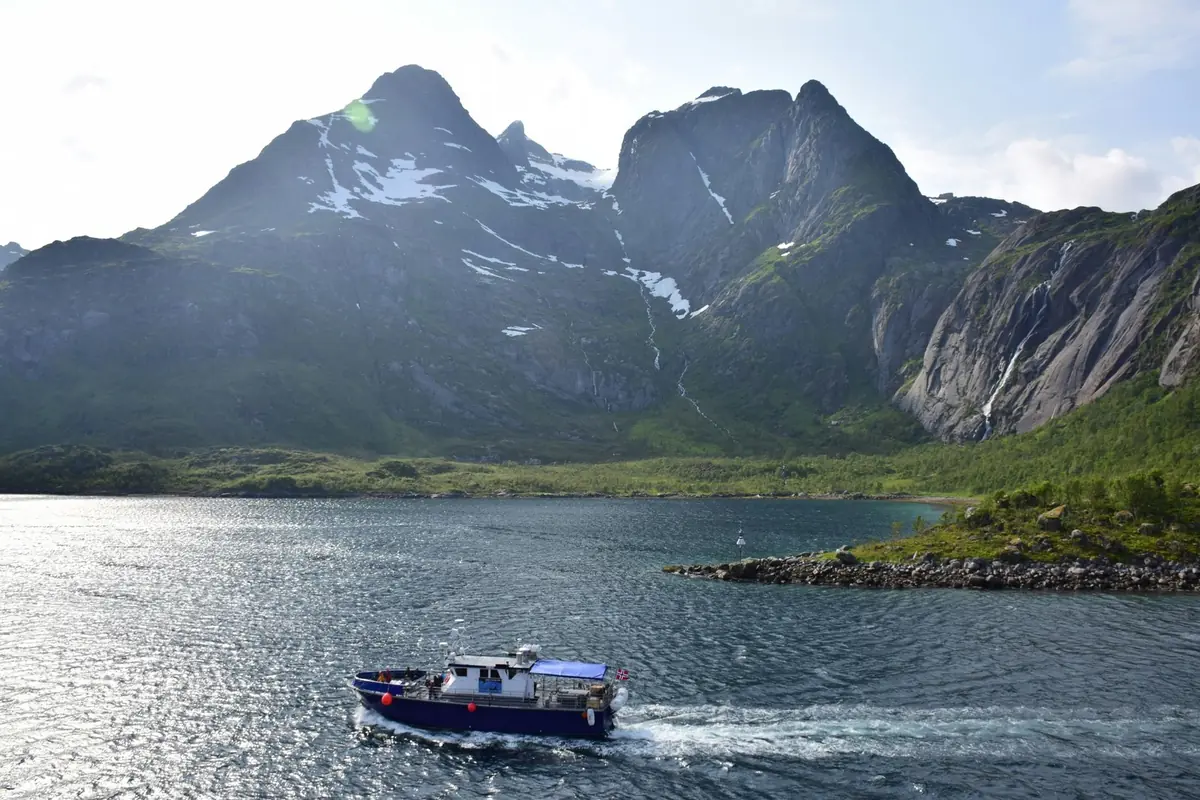
Norway is a country where public transport is often part of the travel experience itself. Long-distance buses cross mountain valleys and connect cities that are not directly served by rail, while ferries and express boats link fjord communities, islands and coastal towns.
For many journeys, the best way to travel is not necessarily the fastest. A combination of bus, ferry and boat can provide access to places that would otherwise be difficult to reach by car or train.
Norway's national travel planner, Entur, brings together information from buses, trains, ferries, boats and other public transport services. It can therefore be particularly useful when a journey requires several different transport modes.
59.1 Understanding Norway's Bus Network
Buses are one of the most important forms of public transport in Norway.
They operate at several levels: local city and regional buses, long-distance express buses, airport buses, scenic and seasonal bus services, rural and island connections, bus services connecting with trains and ferries.
In cities such as Oslo, Bergen, Stavanger, Trondheim and Tromsø, buses form an important part of the local transport network.
Outside the major cities, buses can become particularly important because some smaller towns and rural destinations have no railway station.
Long-distance bus services also connect major Norwegian cities. Visit Norway lists operators such as Vy Express and NOR-WAY Bussekspress among the country's major express-bus services.
59.2 Long-Distance Bus Travel
A long-distance bus can sometimes be a practical alternative to the train, particularly when travelling between destinations that are not directly connected by rail.
For example, current Entur journey information shows direct bus services between Oslo and Stavanger, Oslo and Bergen, Oslo and Trondheim, Oslo and Kristiansand, and other major towns and regional destinations.
Current journey times and departure frequencies vary by date and season, so travellers should check the timetable for their exact travel day.
A useful example is the Oslo–Stavanger journey. Current Entur information shows direct bus services with journey times of around eight hours, while the direct train takes roughly eight hours as well. Exact schedules change. Advantages: buses reach places without railway stations, offer direct connections between many towns, can be cheaper than some last-minute transport options, often connect naturally with local buses and ferries, provide an alternative when trains are fully booked.
Things to consider: long-distance bus journeys can take several hours, and mountain roads may be affected by weather, traffic or road conditions.
During winter, always allow extra time when making an important connection.
59.3 How to Plan a Bus Journey
- Check the exact departure date. 2. Confirm the departure stop. 3. Check whether the service is direct. 4. Check luggage conditions. 5. Allow extra time for transfers. 6. Check whether the service is seasonal. 7. Recheck the timetable shortly before departure.
This is particularly important in rural Norway, where some services operate only a few times per day.
A missed bus can therefore have a much greater impact than missing a frequent city service.
59.4 Ferries Are Part of the Norwegian Transport System
Norway's geography makes ferries essential.
The country has deep fjords, thousands of islands and numerous coastal communities. In many areas, a ferry is not simply a tourist attraction — it is a normal part of the road network and public transport system.
Visit Norway describes ferries and boats as some of the country's most important transport modes. Ferries can significantly shorten journeys that would otherwise require long drives around fjords.
Car Ferries carry: cars, motorhomes, motorcycles, bicycles, pedestrians. They are particularly important on road trips.
Passenger Ferries and Express Boats primarily carry passengers and connect: islands, coastal towns, fjord communities, regional centres. Some services also allow bicycles, although conditions vary by route.
59.5 How Norwegian Car Ferries Work
For a road trip, encountering a ferry is completely normal.
You simply drive to the ferry terminal and follow the signs and lane markings.
Depending on the route and payment system, the vehicle may be registered automatically or payment may be handled according to the specific ferry operator's system.
Because arrangements can change, travellers should check the current information for their route before travelling.
Important ferry tips: check the next departure before leaving, arrive early during busy summer periods, follow lane instructions at the terminal, keep your vehicle in the designated lane, do not assume every ferry operates all night, check whether the route is seasonal, allow additional time when travelling with a motorhome, keep children supervised around ferry terminals and decks.
Popular ferry routes can experience queues during the summer. Visit Norway specifically recommends arriving early for several heavily used connections, including Geiranger–Hellesylt, Lauvvik–Lysebotn, Bognes–Lødingen and Bodø–Moskenes.
59.6 Ferry Travel in the Fjords
Some of Norway's most memorable journeys involve ferries crossing fjords.
A ferry can transform a road journey into a sightseeing experience.
You may leave a small village, drive aboard a ferry, park your vehicle, walk onto the deck and suddenly find yourself surrounded by steep mountains, waterfalls, snow-covered peaks, small farms, coastal villages, deep blue fjord water.
The journey may last only a short time, but it can become one of the highlights of a road trip.
59.7 Express Boats
Express boats are particularly important in coastal Norway.
They are faster passenger vessels that connect communities along fjords and open coastal waters.
They can be especially useful for travellers exploring: Western Norway, Trøndelag, Nordland, coastal islands, the Lofoten region, Helgeland, Bodø and surrounding islands.
For example, the Kystekspressen route between Trondheim and Kristiansund connects coastal communities and takes approximately three and a half hours on the current Route 800 service, with several intermediate stops.
Express boats can be an excellent choice when driving between islands would require several ferry crossings.
59.8 Island-Hopping by Public Transport
Norway's coastal transport system makes island-hopping possible without renting a car.
A typical journey might involve train → bus → express boat → local bus → ferry.
This may sound complicated, but integrated journey planning makes it much easier to identify connections.
Some of the most interesting island and coastal travel opportunities can be found in: Lofoten, Vesterålen, Helgeland, Nordland, Trøndelag, Møre og Romsdal, Western Norway.
The key is to check the complete journey rather than looking at each transport company separately.
59.9 Entur: Planning Combined Journeys
Entur is Norway's national public transport journey planner.
It brings together information from multiple transport modes, including bus, train, ferry, express boat, tram, metro, airport transport, other local public transport.
Entur's journey planner allows travellers to search for journeys across different transport modes rather than planning every section separately.
This is particularly valuable for visitors who are unfamiliar with Norway's geography.
For example, Bergen → bus → ferry → small village can be searched as one journey rather than as two completely separate trips.
59.10 Building a Multi-Transport Journey
When planning a journey with several transport modes, think about the journey in sections.
Example: Oslo → train → Bergen → bus → fjord village → ferry → island.
Instead of booking everything immediately, first check: 1. Arrival time of the train. 2. Departure time of the connecting bus. 3. Walking distance between stops. 4. Ferry departure. 5. Final connection. 6. Frequency of each service. 7. What happens if the first service is delayed.
This is especially important when there are only one or two departures per day.
59.11 Connection Time: Do Not Cut It Too Close
Norway's transport network can be reliable, but weather and geography can affect travel times.
A connection of only 5–10 minutes may be risky when: you are changing transport operators, you have luggage, you need to walk between terminals, the first service travels through mountainous terrain, the connection is the final departure of the day.
For important connections, a larger buffer is usually more comfortable.
If the next service is frequent, a shorter connection may be acceptable. If there is only one departure later that day, missing it could require an overnight stay.
59.12 Coastal Travel Without a Car
Travelling Norway's coast without a car is entirely possible, although planning becomes more important in remote areas.
A car-free coastal trip can combine train, long-distance bus, local bus, ferry, express boat, walking, bicycle.
This style of travel can work particularly well for travellers who want to concentrate on scenery rather than driving.
It is also useful for visitors who do not want to deal with parking, tolls, fuel, ferry queues with a vehicle, mountain driving, winter road conditions.
59.13 The Norwegian Coastal Express
One of Norway's most famous coastal journeys is the route between Bergen and Kirkenes.
The traditional Norwegian Coastal Express has operated for more than 130 years and serves communities along the Norwegian coast. Today, Hurtigruten and Havila Voyages operate coastal services on this route.
The coastal voyage is different from an ordinary cruise.
The ships serve coastal communities and make numerous port calls. Passengers can use the service for a longer coastal holiday or for individual port-to-port journeys.
A complete Bergen–Kirkenes–Bergen journey takes around 11 days according to Visit Norway, while travelling one way takes approximately six to seven days depending on the itinerary.
59.14 What Makes the Coastal Express Special?
The route provides access to scenery that can be difficult to experience from roads.
Depending on the itinerary and season, travellers can see: fjords, fishing villages, Arctic islands, mountain ranges, waterfalls, coastal wildlife, Midnight Sun, Northern Lights, small northern communities.
For many travellers, the attraction is not simply reaching the destination. The voyage itself becomes the experience.
59.15 Coastal Express vs Ordinary Cruise
Coastal Express — serves coastal communities, many port calls, can offer port-to-port travel, strong connection with Norwegian coastal life, suitable for exploring multiple coastal destinations.
Traditional Cruise — primarily designed as a cruise holiday, selected tourist ports, usually sold as a cruise itinerary, more resort-style experience, often focused on onboard experience.
The exact services, ships, cabins and itineraries vary by operator and season.
59.16 Ferry vs Express Boat
Car Ferry — cars usually yes, motorhomes usually yes, pedestrians yes, bicycles often possible, main purpose road connection, typical setting fjords and road crossings.
Express Boat — cars usually no, motorhomes no, pedestrians yes, bicycles route-dependent, main purpose passenger connection, typical setting coastal and island routes.
Both can be part of a memorable Norwegian itinerary.
59.17 Travelling with Luggage
Public transport is easier when luggage is manageable.
For bus and boat journeys: use luggage with strong wheels, keep essential medication in your hand luggage, keep travel documents easily accessible, carry a warm layer even in summer, use a waterproof cover for sensitive luggage during wet weather, avoid oversized luggage unless the operator specifically permits it.
For ferry travel, remember that you may leave your vehicle or designated seating area and spend time outside on deck.
59.18 Travelling with Children
Bus and ferry travel can be enjoyable for families.
Children often enjoy ferry crossings because they can watch the scenery, see boats, walk on deck, look for birds, experience fjords from the water.
However, ferry decks can be windy and slippery. Parents should keep young children close and follow crew instructions.
For longer bus journeys, carry snacks, water, entertainment, warm clothing, small travel games, any required medication.
59.19 Travelling in Winter
Winter changes the experience of bus and ferry travel.
Road conditions can be affected by snow, ice, strong winds, heavy rain, avalanches, temporary road closures.
Ferries and boats can also be affected by severe weather.
Before travelling in winter: 1. Check the latest departure information. 2. Check road and weather conditions. 3. Avoid extremely tight connections. 4. Keep warm clothing accessible. 5. Have a backup plan for remote destinations.
A journey that normally takes three hours may take longer under difficult conditions.
59.20 Summer Travel and Ferry Queues
Summer is one of the busiest periods for Norwegian travel.
Popular ferry routes can become busy, particularly around major tourist destinations.
Allow additional time if travelling with a car, with a motorhome, on a popular fjord route, during weekends, during school holidays, on sunny summer days.
The ferry terminal itself can become part of the journey, so arriving early is often more comfortable than arriving at the last possible minute.
59.21 Scenic Bus Journeys
Not all scenic journeys require a train or car.
Some bus routes travel through mountain valleys, fjord landscapes, coastal roads, Arctic terrain, small villages, national parks.
Bus travel can therefore be a sightseeing experience rather than simply a method of transportation.
When choosing between two routes, consider not only journey time but also landscape, stops, connection quality, season, weather, daylight hours.
A slightly longer route may offer considerably better scenery.
59.22 Famous Bus-and-Ferry Combinations
Western Norway — excellent for Bergen, Hardangerfjord, Sognefjord, Flåm, Ålesund, Geiranger.
Helgeland — excellent for island-hopping, coastal roads, express boats, ferries, mountain scenery.
Lofoten and Vesterålen — excellent for local buses, ferries, coastal connections, island exploration.
Northern Norway — useful for reaching Tromsø, Senja, Narvik, Vesterålen, Lofoten, Finnmark.
Transport frequency can be limited in remote areas, so careful planning is essential.
59.23 International Ferry Travel to Norway
Norway can also be reached by ferry from other European countries.
Regular international ferry connections include routes involving Denmark, Sweden, Germany.
Visit Norway lists connections from places including Copenhagen, Frederikshavn, Hirtshals, Strömstad and Kiel.
For travellers bringing a car, an international ferry can be a practical alternative to flying and renting a vehicle.
However, compare ferry fare, vehicle cost, cabin cost, fuel, toll expenses, travel time, rental-car cost before choosing the best option.
59.24 Ferry Travel With a Rental Car
A rental car can normally be taken onto Norwegian car ferries where the route accepts vehicles.
The important point is to understand that a ferry crossing does not necessarily mean you must return the vehicle to the same location.
A road-trip itinerary can therefore use ferries as part of a one-way route.
For example: Bergen → Hardanger → ferry → fjord region → Flåm → Sognefjord → Bergen. This can be more efficient than repeatedly returning to the same city.
Always check the rental company's conditions if crossing borders or using special transport services.
59.25 Accessibility
Travellers with reduced mobility should check individual services before departure.
Accessibility can vary between bus stations, ferry terminals, boats, rural stops, older vessels, smaller local services.
When planning a journey, consider step-free boarding, wheelchair space, accessible toilets, boarding ramps, assistance requirements, connection distances.
Entur's journey planner includes accessibility-related journey options, including accessible walking routes in its search interface.
59.26 A Practical Bus-and-Ferry Packing List
- Essential: passport or identification, ticket or booking confirmation, mobile phone, charging cable, power bank, bank card, water, snacks.
- For coastal travel: waterproof jacket, warm layer, comfortable shoes, sunglasses, small backpack, camera.
- For families: children's snacks, entertainment, spare clothing, required medication, small travel games.
59.27 Sample 7-Day Coastal Public Transport Journey
Day 1 — Bergen: explore Bergen and stay overnight.
Day 2 — Bergen to Fjord Region: travel by bus and/or boat toward the fjords.
Day 3 — Fjord Exploration: use local buses and boats to explore nearby villages and viewpoints.
Day 4 — Continue Toward Flåm: combine boat and rail connections where practical.
Day 5 — Flåm to Sognefjord Region: continue by boat or bus depending on the seasonal timetable.
Day 6 — Coastal Connection: travel toward another coastal town using bus and ferry connections.
Day 7 — Return or Continue: continue to the next major city or return toward Bergen.
Exact routes should be built around the current timetable because seasonal transport frequencies vary.
59.28 Five Important Rules for Public Transport in Norway
- Rule 1: check the whole journey — do not look only at the first bus or ferry.
- Rule 2: respect rural timetables — a missed departure can sometimes mean waiting several hours or until the next day.
- Rule 3: leave connection time — Norway's geography can make delays more difficult to recover from.
- Rule 4: check seasonal services — some routes have very different summer and winter schedules.
- Rule 5: recheck before departure — timetables and operating conditions can change.
59.29 Bus, Ferry or Car?
City travel — bus excellent, ferry/boat limited, car good but parking can be difficult.
Fjord travel — all three excellent.
Island travel — bus good, ferry/boat excellent, car route-dependent.
Remote villages — bus variable, ferry/boat often useful, car excellent.
Road trips — bus limited, ferry/boat essential on some routes, car excellent.
No driving required — bus and ferry/boat yes, car no.
Winter flexibility — bus variable, ferry/boat weather-dependent, car requires careful driving.
There is no single transport method that works best everywhere in Norway. The most effective itinerary often combines several.
59.30 Final Planning Checklist
Departure date, departure time, correct terminal or stop, ticket requirements, luggage conditions, ferry departure, connection time, final destination, weather forecast, road conditions if using buses, seasonal timetable, backup plan.
Final Thoughts
Norway's buses, ferries and coastal boats are much more than practical transportation.
They connect communities separated by mountains, fjords and sea, and they allow visitors to reach landscapes that would otherwise require complicated road journeys.
A ferry crossing can become a scenic experience. A long-distance bus can reveal mountain valleys and remote villages. An express boat can turn an island journey into one of the highlights of a holiday.
The most important principle is simple: plan the complete journey, not just the individual transport sections.
Check current schedules, allow sensible connection time, prepare for changing weather and remember that remote Norway operates at a different pace from a major European city.
For public transport planning, Entur (entur.no) brings together information from across Norway's public transport network; check official transport and destination sources again before your journey.
Norway is not merely a country you travel through. On its buses, ferries and coastal boats, the journey itself becomes part of the destination.