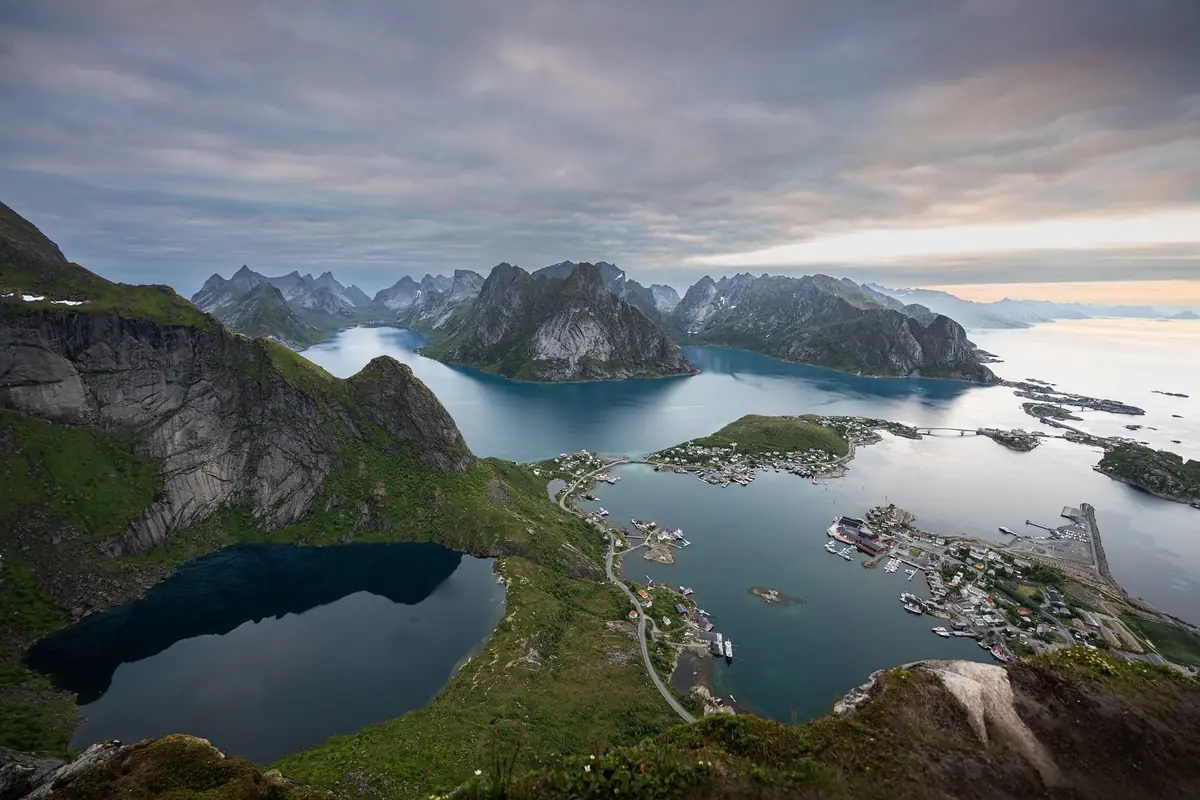
Few destinations in Norway look as dramatic as the Lofoten Islands.
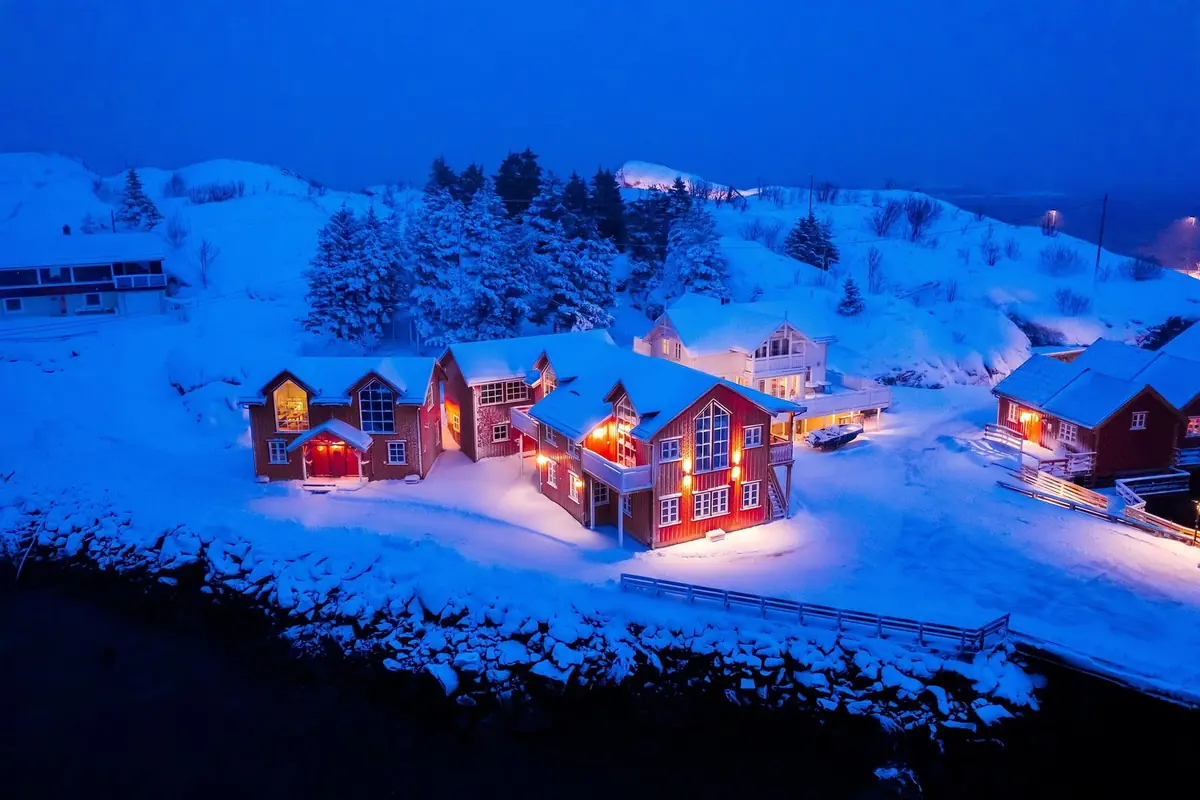
Sharp mountains rise almost directly from the sea. Small fishing villages sit beside turquoise water. Red wooden rorbuer contrast with green mountains, white beaches and deep blue fjords.
Located north of the Arctic Circle, Lofoten offers two extraordinary seasonal experiences: Midnight Sun in summer and Northern Lights during the darker months.
Lofoten is not simply one destination. It is a chain of islands and communities connected by bridges, tunnels, ferries and the E10 road.
The best way to experience it is slowly.
8.1 Lofoten at a Glance
- Region: Nordland
- Location: Northern Norway, above the Arctic Circle
- Ideal stay: 4–7 days
- Best for: Road trips, photography, hiking, beaches, fishing villages, surfing, kayaking and Arctic landscapes
- Major destinations include: Svolvær, Henningsvær, Kabelvåg, Leknes, Nusfjord, Ramberg, Reine, Hamnøy, Sørvågen, Å.
The Norwegian Scenic Route Lofoten runs approximately 230 kilometres between Raftsundet and Å, with several recommended detours. Official guidance recommends allowing at least two days, while a longer stay gives travellers considerably more time to explore.
8.2 Why Visit Lofoten?
Lofoten combines landscapes that normally require several different destinations to experience.
Here you can find: dramatic mountains, fjords, fishing villages, white-sand beaches, surfing, hiking, kayaking, wildlife, Northern Lights, Midnight Sun, traditional fishing culture, scenic roads.
Visit Norway highlights places including Reine, Ballstad and Henningsvær, as well as beaches such as Haukland, Ramberg and Uttakleiv.
8.3 The Lofoten Scenic Route
The Norwegian Scenic Route Lofoten is one of Norway's 18 official Scenic Routes.
The route stretches from Raftsundet in the north to Å in the south.
Along the way, travellers can take detours to: Nusfjord, Vikten, Utakleiv, Unstad, Eggum, Henningsvær, Grunnfør.
The route combines dramatic coastline, mountain landscapes, fishing communities and specially designed viewpoints and rest areas.
Road-trip philosophy: do not treat the route as a race. The purpose is to stop, photograph, walk, eat, explore, and continue when you are ready.
8.4 Svolvær — The Gateway to Lofoten
Svolvær is one of the main towns in Lofoten and a convenient base for exploring the northern part of the islands.
It offers: restaurants, hotels, galleries, boat excursions, fishing trips, kayaking, hiking, shops, transport connections.
The surrounding landscape is dominated by mountains and the sea.
Recommended stay: 1–2 nights for travellers using Svolvær as a northern base.
8.5 Svolvær Goat
One of Svolvær's most recognisable mountain formations is Svolværgeita, often called the Svolvær Goat.
The two rock horns are visible above the town and have become an iconic symbol of Lofoten climbing.
Experienced climbers can undertake climbing routes in the area, while ordinary visitors can simply admire the formation from below.
Safety: technical climbing should only be attempted with appropriate experience, equipment and guidance.
8.6 Henningsvær — The Venice of Lofoten
Henningsvær is one of the archipelago's most famous fishing villages.
The settlement spreads across several small islands connected by bridges.
Its location between mountains and the Vestfjord gives it an unforgettable appearance. Visit Norway describes Henningsvær as a famous fishing village with around 500 permanent residents.
Explore: harbour, cafés, restaurants, art galleries, fishing culture, local shops, coastal views.
8.7 Henningsvær Football Field
One of Lofoten's most photographed locations is the football pitch at Henningsvær.
The pitch is surrounded by the sea and rocky coastline.
From above, its unusual setting creates a spectacular photograph.
Important: the pitch is part of a local community. Visitors should admire and photograph the area without interfering with local activities.
8.8 Kabelvåg
Kabelvåg is another historic settlement in Lofoten.
It has strong connections to the traditional cod-fishing industry and provides a quieter alternative to some of the more heavily visited destinations.
It is also home to cultural attractions and is located close to Svolvær.
Combine: Svolvær → Kabelvåg → Henningsvær for an excellent northern Lofoten day.
8.9 Reine — The Iconic Lofoten Village
If you have seen photographs of Lofoten, there is a good chance you have seen Reine.
The village sits among dramatic mountains and waterways, with traditional red fishing cabins creating the classic Lofoten scene.
Visit Lofoten describes Reine as an active fishing village and asks visitors to respect local residents, private property and the working fishing community.
Explore Reine: harbour, rorbuer, cafés, galleries, kayaking, boat excursions, Reinebringen, nearby Hamnøy.
8.10 Rorbuer — Traditional Fishing Cabins
One of the most memorable accommodation experiences in Lofoten is staying in a rorbu.
Traditional fishermen's cabins have been converted into tourist accommodation in many places.
A rorbu stay allows visitors to experience the traditional architecture of Lofoten while enjoying modern facilities.
Best locations: look for rorbuer around Reine, Hamnøy, Å, Nusfjord, Svolvær, Henningsvær.
8.11 Hamnøy
Hamnøy is one of the most photographed areas in Lofoten.
Traditional red cabins stand beside the water while steep mountains rise behind them.
The classic viewpoint near the bridge provides an iconic Lofoten photograph.
Photography tip: try early morning, blue hour, sunset, Midnight Sun depending on the season.
8.12 Reinebringen — The Famous Viewpoint Above Reine
Reinebringen is one of Norway's most popular hikes.
The mountain reaches approximately 484 metres above sea level.
The current Visit Lofoten information lists: distance approximately 2 km round trip, duration approximately 1–2 hours, season May–September, difficulty medium/demanding, steep Sherpa-built stairs.
The view from the top includes: Reine, fjords, mountains, islands, fishing villages.
8.13 Reinebringen Safety
Although the hike is relatively short, it should not be described as an easy walk.
The stairs are steep and sections can feel exposed.
Visit Lofoten recommends sturdy footwear, water and a windproof jacket. It also strongly advises against the hike in winter conditions.
Before hiking, check: weather, trail status, snow/ice, your fitness, crowding, daylight, suitable footwear.
Important: do not leave the marked route.
8.14 Reinebringen Parking
Visitors arriving by car should use designated parking.
Visit Lofoten currently directs hikers towards Reine Ytre Havn and explains that the route continues through Reine towards the trail area.
Parking and access arrangements can change, so check current local information before travelling.
8.15 Å — The End of the Road
At the southern end of the Scenic Route is the village of Å.
The village name is simply Å — one of the most distinctive place names in Norway.
Å preserves the traditional atmosphere of an old fishing village and is home to the Norwegian Fishing Village Museum.
The museum uses original buildings and interiors to explain the history of fishing communities in Lofoten.
8.16 Norwegian Fishing Village Museum
The museum is an excellent place to understand how Lofoten developed around fishing.
Visitors can learn about: fishing, stockfish production, boats, traditional homes, fishermen's lives, local industry.
This is particularly valuable because Lofoten is not simply a beautiful landscape — it is a living cultural region.
8.17 Nusfjord — One of Norway's Best-Preserved Fishing Villages
Nusfjord is a historic fishing village and one of the most interesting detours from the Scenic Route.
The village includes: rorbuer, historic buildings, restaurant, café, galleries, coastal scenery, traditional fishing atmosphere.
Visit Norway describes Nusfjord as one of Norway's best-preserved fishing villages.
Suggested time: allow 2–4 hours if you want to explore properly rather than simply photograph the entrance.
8.18 Lofoten's Beaches
One of the biggest surprises for visitors is the number of beautiful beaches.
Popular examples include: Hauklandstranda, Uttakleiv, Rambergstranda, Skagsanden, Unstad, Rørvika, Bunesstranda.
Visit Norway specifically highlights several of these beaches as summer attractions.
The water can look tropical in photographs. The temperature, however, remains Arctic.
8.19 Haukland Beach
Hauklandstranda is famous for: white sand, turquoise water, dramatic mountains, photography, walking.
It is one of the classic Lofoten landscapes.
A nearby modern café provides a useful stop for travellers exploring the area.
Best for: summer road trips + photography + short walks.
8.20 Uttakleiv Beach
Uttakleiv offers another spectacular coastal landscape.
The combination of rocky shoreline, mountains, ocean, beach, Arctic light makes it particularly popular with photographers.
Photography: sunrise, sunset and Midnight Sun periods can all create excellent conditions. Always check local parking and camping rules.
8.21 Rambergstranda
Rambergstranda is another white-sand beach along the Scenic Route.
The beach can be reached easily by road and works well as a short road-trip stop.
A nearby camping facility provides an option for travellers who want to stay close to the coastline.
8.22 Unstad — Surfing in the Arctic
Lofoten is not only for sightseeing.
Unstad has become famous for surfing beneath dramatic Arctic mountains.
Visit Norway describes it as a surfing destination where waves arrive from the Atlantic throughout the year.
You can: take surfing lessons, watch experienced surfers, walk along the beach, photograph the coastline, enjoy the surrounding mountains.
The combination of surfing and Arctic scenery makes Unstad particularly unusual.
8.23 Vikten
Vikten is known for traditional crafts and a glassblowing studio.
The Scenic Route recommends the detour for travellers interested in local craftsmanship.
Travel idea: stop here to see local craftsmanship → visit the coast → continue towards Nusfjord.
8.24 Eggum
Eggum sits on the exposed Atlantic side of Lofoten.
The landscape here feels different from the protected fjords.
You get: open ocean, coastal mountains, wind, walking routes, dramatic skies.
The Scenic Route includes a distinctive rest area at Eggum designed as an amphitheatre.
8.25 Lofoten and the Midnight Sun
During summer, Lofoten experiences the Midnight Sun.
This means travellers can explore long after conventional sunset.
Great activities: midnight hiking, beach photography, kayaking, fishing, cycling, road trips, camping at designated sites.
Reinebringen can also be particularly atmospheric during Midnight Sun season, although the trail remains steep and popular.
8.26 Northern Lights in Lofoten
Lofoten is also a Northern Lights destination.
Visit Lofoten currently describes the aurora season as approximately September to April.
Best strategy: stay several nights. Watch cloud forecast, aurora forecast, local weather, road conditions.
The Northern Lights are never guaranteed.
8.27 Lofoten Hiking
Popular hikes include: Reinebringen, Offersøykammen, Ryten, Kvalvika, Festvågtind, Tjeldbergtind.
Difficulty varies enormously. A short-looking Lofoten hike can still involve steep rock, exposure and rapidly changing weather.
Visit Lofoten warns that weather can change quickly, with sunshine potentially turning into fog, wind and rain.
Mountain rule: if conditions become unsafe, turn around. The summit is never more important than getting back safely.
8.28 Kvalvika Beach & Ryten
Kvalvika is one of Lofoten's most dramatic beaches.
The beach is surrounded by mountains and can be reached through hiking routes.
Nearby Ryten provides an elevated viewpoint over the beach.
Important: conditions can become difficult in rain, fog, strong wind, snow, ice. Plan the route according to the season.
8.29 Kayaking
Lofoten's combination of islands and sheltered waters creates excellent opportunities for kayaking.
Possible experiences include: guided sea kayaking, wildlife kayaking, fjord kayaking, sunrise/sunset trips, multi-hour excursions.
Beginners should choose guided tours rather than heading onto open water alone.
8.30 Fishing
Fishing has been central to Lofoten's identity for centuries.
Visitors can join: sea fishing trips, local fishing tours, RIB excursions, boat trips.
Traditional fishing culture is especially visible during the cod-fishing season.
8.31 Stockfish
One of Lofoten's defining products is stockfish — dried fish traditionally produced from cod.
Large wooden racks holding drying fish are a familiar sight in parts of Lofoten during the appropriate season.
For travellers interested in Norwegian food culture, stockfish is an important part of understanding the region.
8.32 Lofoten Road Trip
A classic road-trip route can be structured as:
Svolvær → Kabelvåg → Henningsvær → Gimsøya → Unstad → Eggum → Haukland → Leknes → Nusfjord → Ramberg → Reine → Hamnøy → Sørvågen → Å
This follows the main Scenic Route concept while allowing detours.
8.33 How Many Days Do You Need?
2 Days — possible, but rushed. Focus on: Svolvær + Henningsvær + Reine.
4 Days — a good introduction. Add: beaches + Nusfjord + Å.
5–7 Days — much better. You can include: hiking, beaches, fishing, kayaking, villages, scenic road, photography.
7+ Days — ideal for travellers who want a slower experience.
8.34 A Perfect 3-Day Lofoten Itinerary
Day 1 — Svolvær & Henningsvær: Morning — Svolvær, harbour, local lunch. Afternoon — Kabelvåg, Henningsvær. Evening — sunset photography.
Day 2 — Beaches & Nusfjord: Morning — Haukland. Afternoon — Uttakleiv, Nusfjord. Evening — Ramberg.
Day 3 — Reine & Å: Morning — Reine, Hamnøy. Afternoon — Reinebringen if conditions are suitable. Evening — Sørvågen, Å.
8.35 A Perfect 5-Day Lofoten Itinerary
- Day 1: Svolvær + Kabelvåg.
- Day 2: Henningsvær + Gimsøya.
- Day 3: Unstad + Eggum + Haukland + Uttakleiv.
- Day 4: Nusfjord + Ramberg + Flakstad.
- Day 5: Reine + Hamnøy + Å.
This gives travellers considerably more time for photography and weather flexibility.
8.36 A Perfect 7-Day Lofoten Road Trip
- Day 1: Svolvær.
- Day 2: Henningsvær + Kabelvåg.
- Day 3: Gimsøya + Unstad + Eggum.
- Day 4: Haukland + Uttakleiv + Leknes.
- Day 5: Nusfjord + Ramberg + Flakstad.
- Day 6: Reine + Hamnøy + Reinebringen.
- Day 7: Sørvågen + Å + Norwegian Fishing Village Museum.
The itinerary can be adjusted according to weather.
8.37 Travelling Without a Car
Lofoten can be explored without driving, but a car provides much greater flexibility.
Public buses connect many communities, while ferries and seasonal transport services can connect different parts of the region.
Check current journey planners (entur.no) and ferry schedules before travelling.
Car-free strategy: base yourself in Svolvær or Leknes and take regional buses and organised excursions. For Reine and southern Lofoten, staying locally can reduce travel time.
8.38 Driving in Lofoten
The main E10 is the backbone of the islands.
However, some roads are narrow and can become busy during summer.
The official Scenic Route guidance notes heavy traffic during peak summer, particularly July to mid-August. It also warns that some roads are narrow and that winter driving can be challenging.
Driving rules: allow local traffic to pass, use proper parking, do not stop in unsafe locations, do not block viewpoints, follow road signs, check ferry schedules, check live road information.
8.39 Camping in Lofoten
Lofoten has many beautiful camping locations.
However, the huge number of summer visitors places pressure on local communities and the environment.
The official Scenic Route guidance recommends using designated campsites and notes that campsites can become busy in July and August.
Do not assume "beautiful empty land = free camping." Local rules and restrictions apply. Always check where camping is permitted.
8.40 Responsible Tourism
Lofoten is a living community, not an outdoor theme park.
Visitors should: respect residents, use public toilets, park legally, keep roads clear, take rubbish away, stay on marked trails, avoid damaging vegetation, use designated campsites, respect private property, avoid entering private areas.
Visit Lofoten specifically asks visitors to respect the privacy of residents in Reine and to use public campsites rather than camping elsewhere.
8.41 Lofoten Weather
Lofoten weather can change rapidly. You may experience sun → wind → rain → fog within a short period.
Visit Lofoten warns that temperatures can remain in single digits even during summer and that local weather can vary considerably.
Always pack: waterproof jacket, warm layer, proper shoes, extra dry clothing, water, phone, power bank.
8.42 Photography Guide
Classic photographs: 1. Reine — fishing village + mountains. 2. Hamnøy — red rorbuer + mountain background. 3. Henningsvær — village + sea + mountains. 4. Haukland — white beach + turquoise water. 5. Uttakleiv — rocky coast + Arctic mountains. 6. Reinebringen — high panoramic view. 7. Midnight Sun — golden light across the sea. 8. Northern Lights — aurora above mountains.
8.43 Suggested Routes
- Route 1 — northern Lofoten: Svolvær → Kabelvåg → Henningsvær → Gimsøya.
- Route 2 — central Lofoten: Unstad → Eggum → Haukland → Uttakleiv → Leknes → Nusfjord.
- Route 3 — southern Lofoten: Ramberg → Reine → Hamnøy → Sørvågen → Å.
The complete Lofoten Scenic Route runs for about 230 km from Raftsundet to Å.
8.45 Lofoten Quick Reference
| Svolvær | 1–2 days | base/city |
|---|---|---|
| Henningsvær | 2–4 hrs | fishing village |
| Kabelvåg | 1–3 hrs | culture/history |
| Unstad | 2–4 hrs | surfing/coast |
| Haukland | 1–3 hrs | beach |
| Uttakleiv | 1–3 hrs | photography |
| Nusfjord | 2–4 hrs | heritage |
| Ramberg | 1–2 hrs | beach/road trip |
| Reine | 2–5 hrs | village |
| Reinebringen | 1–2 hrs | hiking/view |
| Hamnøy | 30–90 min | photography |
| Å | 2–4 hrs | fishing history |
8.47 Check Before You Go
Before you travel, check: E10 road conditions, ferry and bus schedules, Reinebringen trail status, hiking conditions, campsite availability, parking rules, museum opening hours, attraction prices, weather and Northern Lights forecasts.
The official Scenic Route website currently notes that some road infrastructure is subject to seasonal or maintenance-related restrictions, so live road information should always be checked before departure.
8.48 Lofoten in One Sentence
Lofoten is where Arctic mountains rise directly from the sea, traditional fishing villages meet white beaches, and every turn of the road can become a postcard.
Chapter Summary
Svolvær — Northern gateway. Henningsvær — iconic fishing village. Kabelvåg — historic Lofoten. Unstad — Arctic surfing. Haukland — white-sand beach. Uttakleiv — wild coastline. Nusfjord — preserved fishing village. Ramberg — beach and road-trip stop. Reine — iconic Lofoten village. Reinebringen — famous mountain viewpoint. Hamnøy — classic rorbuer landscape. Å — historic fishing village. Midnight Sun — endless summer light. Northern Lights — Arctic winter spectacle.
Take your time in Lofoten. The destination is not one viewpoint or one village — it is the entire journey between them.