30.1 The Far North Begins Here
Few places in Norway feel as remote as the landscape around Nordkapp (North Cape).
Here, the road reaches the far northern edge of Magerøya, where a 307-metre-high cliff rises above the Arctic Ocean.
The area combines: Arctic coastline, treeless tundra, fishing villages, Sámi heritage, bird cliffs, reindeer, Midnight Sun, Polar Night, Northern Lights, long-distance road journeys.
The North Cape itself is the region's most famous landmark, but the surrounding communities and landscapes deserve several days rather than a quick photo stop.
30.2 North Cape — Nordkapp
The North Cape Plateau is one of Norway's most recognisable travel landmarks.
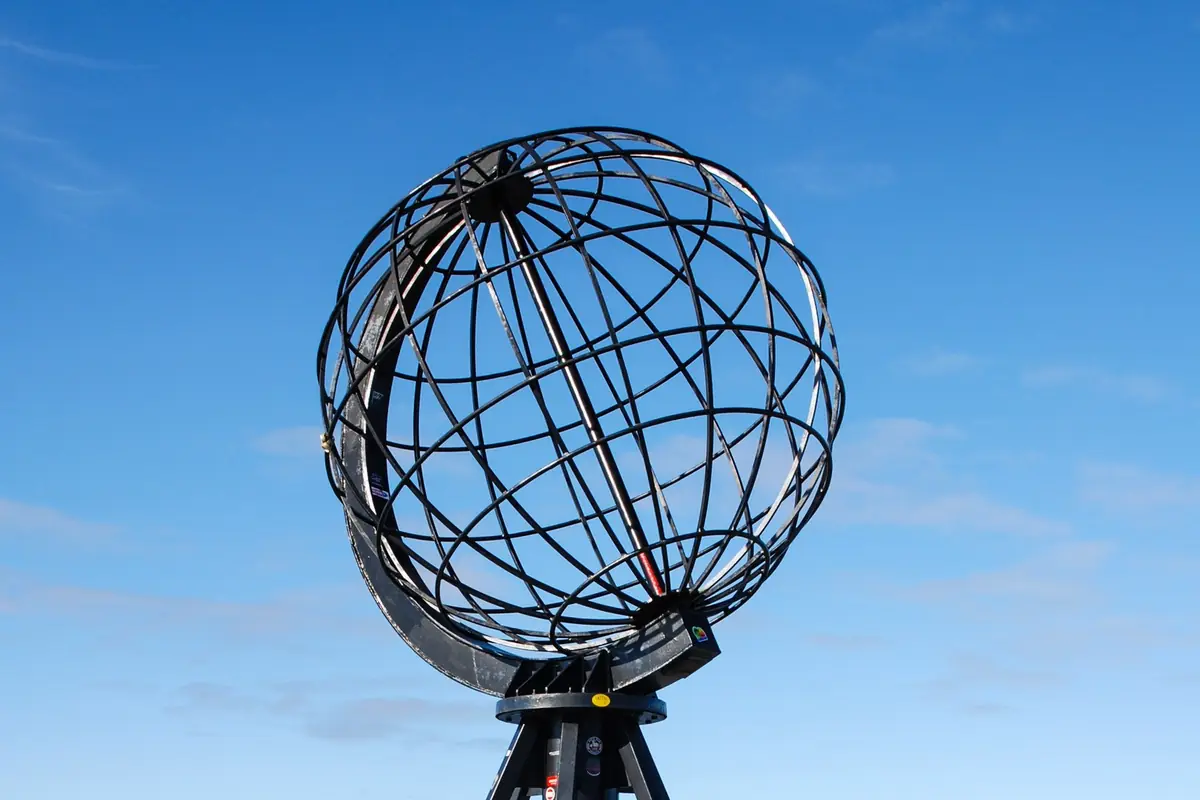
At the edge of the plateau stands the famous globe monument overlooking the Arctic Ocean.
The cliff drops approximately 307 metres to the sea.
The North Cape is located at approximately 71°10¢ north, making it one of Europe's most northerly accessible tourist destinations by road.
30.3 Is North Cape Really Europe's Northernmost Point?
There is an important geographical distinction.
The North Cape is the famous and easily accessible landmark.
However, Knivskjellodden, also on Magerøya, extends farther north.
Knivskjellodden is therefore technically farther north than the North Cape.
This is why travellers sometimes see two different descriptions of Europe's northernmost point.
For most visitors, the North Cape provides the classic experience because it is accessible by road and has a visitor centre.
30.4 The North Cape Globe
The globe monument has become the visual symbol of Nordkapp.
It represents the idea of standing at the northern edge of Europe and looking towards the Arctic Ocean.
The surrounding plateau is open and exposed, so weather can change quickly.
Fog can arrive suddenly, while strong winds are possible even during summer. Nordkapphallen specifically advises visitors to check weather and road conditions before travelling.
30.5 Nordkapphallen
The North Cape Hall (Nordkapphallen) is the visitor centre at the plateau.
Facilities include: Arctic exhibitions, panoramic film, historical displays, Cave of Lights, viewing areas, chapel, café, restaurant in the main summer season, gift shop, toilets, Wi-Fi.
The current visitor-centre ticket includes the on-site attractions and allows multiple entries during its validity period.
Opening times and prices can change, so treat the figures here as a guide only.
30.6 North Cape in Summer
Summer is the most popular season.
From approximately 14 May to 29 July, the sun remains above the horizon at Nordkapp, creating the Midnight Sun period.
This means you can visit late at night, around midnight, early in the morning and still experience daylight.
The North Cape Hall currently extends its opening hours well into the night during the peak summer period.
30.7 North Cape in Winter
Winter provides a completely different experience.
The sun remains below the horizon for approximately 21 November to 21 January, creating the Polar Night.
Possible experiences include: Northern Lights, snowmobile excursions, snowshoeing, dog sledding, winter photography, Arctic road trips.
However, access to Nordkapp can be affected by storms and road closures.
The final road section can operate under winter convoy arrangements, so winter travellers must check current conditions before departure.
30.8 Arctic Weather
Do not underestimate the weather at Nordkapp.
Even during summer: temperatures can be low, wind can be strong, fog can reduce visibility, rain can arrive quickly.
Nordkapphallen notes that July averages around 10°C, with wind making it feel colder.
Pack: waterproof jacket, warm mid-layer, hat, gloves, comfortable shoes, windproof clothing.
30.9 Honningsvåg — Gateway to Nordkapp
Honningsvåg is the principal town and practical gateway to North Cape.
It provides: hotels, restaurants, shops, tourist information, harbour, boat excursions, transport connections.
Visit Norway describes Honningsvåg as the gateway for travellers visiting the North Cape.
It is worth staying here rather than treating it purely as a transport stop.
30.10 Honningsvåg Harbour
The harbour gives Honningsvåg a strong maritime identity.
Coastal vessels and cruise ships use the port, while fishing remains an important part of the local character.
A short harbour walk is particularly atmospheric when the Arctic light changes during the evening.
30.11 Arctic Food in Honningsvåg
Local restaurants can provide opportunities to try: cod, Arctic fish, king crab, reindeer, local lamb, seafood, seasonal berries.
King crab is particularly associated with the far northern coast.
For visitors interested in local cuisine, a seafood-focused meal can be an important part of the Nordkapp experience.
30.12 Gjesvær
West of Honningsvåg lies the small fishing village of Gjesvær.
The village provides access to one of the area's most important wildlife attractions: Gjesværstappan.
The offshore cliffs support large seabird colonies.
Visit Norway highlights the area for its puffins, gannets and cormorants.
30.13 Gjesværstappan Bird Cliffs
Gjesværstappan is one of Northern Norway's important seabird areas.
Depending on season, boat excursions can provide opportunities to see: puffins, gannets, cormorants, guillemots, razorbills, sea eagles.
Wildlife numbers and species vary with the season.
Never expect a guaranteed sighting.
30.14 Bird Safari
Boat trips from Gjesvær allow visitors to experience the cliffs from the sea.
This is particularly useful because the nesting colonies are located on offshore islands and cliffs.
The best period for seabird activity is generally during the breeding season.
A wildlife tour also reduces the temptation for visitors to approach nesting areas on their own.
30.15 Skarsvåg — The Northern Fishing Village
Skarsvåg is promoted by Visit Norway as the world's northernmost fishing village.
Its colourful buildings and exposed coastal position make it an interesting stop on a Magerøya road trip.
The village demonstrates how communities have adapted to life at the far northern edge of Europe.
30.16 Kamøyvær
Another small coastal settlement is Kamøyvær.
The village is associated with fishing, coastal culture and local art.
Visit Norway highlights the West of the Moon art gallery in Kamøyvær.
Small settlements such as Kamøyvær are worth including when you want to experience Magerøya beyond the North Cape monument.
30.17 Kirkeporten — The Church Door
Kirkeporten is a natural rock formation shaped like an arch.
The opening provides a dramatic view towards the North Cape Plateau.
It is one of the region's most memorable shorter hikes and offers a different perspective from the main Nordkapp viewpoint.
Visit Norway specifically recommends Kirkeporten for its view towards the North Cape.
30.18 Knivskjellodden
For experienced hikers, Knivskjellodden offers a more remote alternative to the North Cape.
The route leads to the actual northernmost point of Magerøya.
It is considerably less developed than Nordkapp and requires proper preparation.
Expect: exposed terrain, changing weather, long walking distance, no comparable visitor infrastructure.
It should be treated as a wilderness hike rather than a sightseeing walk.
30.19 Porsangerfjord
Before reaching Magerøya, travellers pass through the long Porsangerfjord.
The fjord stretches deep into Finnmark and forms one of the major geographical features of the region.
Its landscape combines: fjord, mountain, birch woodland, tundra, open plateaus.
The journey along the fjord is itself a major part of the North Cape road trip.
30.20 Lakselv
Lakselv is the main settlement at the southern end of Porsangerfjord.
It is an important transport and service centre for travellers exploring: Porsanger, Stabbursdalen, North Cape, Karasjok, Finnmark's interior.
Lakselv is therefore useful as an overnight stop rather than simply a place to refuel.
30.21 Stabbursdalen National Park
Near Lakselv lies Stabbursdalen National Park.
The landscape contains: pine forest, rivers, lakes, mountains, open valleys, Arctic vegetation.
The park provides a useful contrast with the treeless landscapes farther north.
It is particularly interesting because northern pine forest survives this far north.
30.22 Stabbursnes Nature House and Museum
The Stabbursnes Nature House and Museum provides information about the natural and cultural environment of Porsanger.
Topics can include: nature, wildlife, Sámi culture, local history, landscape.
It can be a useful stop before heading deeper into Finnmark.
30.23 Porsanger's Sámi Heritage
Porsanger has a strong Sámi cultural identity.
Travellers may encounter: Sámi place names, reindeer herding, traditional handicrafts, food traditions, cultural landscapes.
Visitors should remember that reindeer herding is a living livelihood, not simply a tourist attraction.
Do not approach herds or interfere with animals.
30.24 Reindeer on the Road
Reindeer can appear on roads throughout Finnmark.
A particularly important rule is: slow down whenever reindeer are near the road.
Do not assume they will move away from your vehicle. They may suddenly cross or remain on the road.
This is especially important during summer when herds may move between seasonal grazing areas.
30.25 Porsanger to North Cape Road Trip
A classic route is: Lakselv → Olderfjord → Porsangerfjord → Honningsvåg → Nordkapp.
The final approach follows E69.
The North Cape Tunnel connects Magerøya with the mainland. The tunnel is approximately 6.8km long, removing the need for a ferry crossing to reach the island.
30.26 Alta to North Cape
North Cape can also be reached from Alta.
Visit Norway currently gives an approximate driving time of 3.5 hours from Alta, although actual journey time depends on weather, traffic and stops.
A public-transport option is also available seasonally.
Visit Norway currently describes the Alta–North Cape bus journey as approximately 4 hours 20 minutes, usually available between May and September.
Check the current timetable before relying on these times.
30.27 Honningsvåg Airport
Honningsvåg Airport, Valan is the closest airport to North Cape.
Visit Norway places it approximately 32km from Nordkapp.
Other useful airports include: Lakselv, Alta.
A rental car can make the final part of the journey much easier.
30.28 Coastal Ship Connections
Honningsvåg is also served by Norway's coastal shipping network.
This creates an alternative way to experience the region.
Travellers can combine coastal voyage + North Cape excursion rather than making the entire journey by road.
Visit Norway notes that both Hurtigruten and Havila call at Honningsvåg.
30.29 Midnight Sun Road Trip
The North Cape region is particularly impressive during the Midnight Sun.
A possible itinerary is: dinner in Honningsvåg → drive to Nordkapp → Midnight Sun → return late at night.
The road remains bright throughout the night during the peak summer period.
Cloud and fog can, however, completely change the experience.
30.30 Northern Lights Road Trip
During winter, a similar journey can be built around the Northern Lights.
Possible route: Lakselv → Porsangerfjord → Honningsvåg → Nordkapp.
But winter travel requires flexibility.
If the final road section closes because of severe weather, do not attempt to force the journey.
Nordkapphallen itself states that road conditions can result in closure and advises checking current conditions before travelling.
30.31 Arctic Ocean Photography
The North Cape area is ideal for wide landscapes.
Photograph: globe monument, cliff edge, Arctic Ocean, reindeer, fishing villages, Porsangerfjord, Gjesvær, Midnight Sun, Northern Lights.
For the North Cape cliff, avoid approaching edges simply for photographs.
Wind and fog can reduce visibility very quickly.
30.32 Family Travel
Families can combine: North Cape, Nordkapphallen, Honningsvåg, bird safari, fishing, king crab experience, short walks, scenic drives.
The North Cape Hall is currently accessible for wheelchair users, with lifts and some wheelchairs available when needed.
30.33 Three-Day North Cape Itinerary
- Day 1 — Porsanger: Lakselv → Porsangerfjord → Stabbursdalen. Overnight around Lakselv or continue north depending on schedule.
- Day 2 — Magerøya: Lakselv → Honningsvåg → Skarsvåg → Nordkapp. Visit Nordkapp in the evening if weather is clear.
- Day 3 — Coastal Magerøya: choose Gjesvær bird safari, Kirkeporten, Kamøyvær, Honningsvåg.
30.34 Four-Day Itinerary
- Day 1: Alta → Lakselv → Porsangerfjord.
- Day 2: Lakselv → Honningsvåg.
- Day 3: Nordkapp + Gjesvær.
- Day 4: Honningsvåg → North Cape area → return south or continue towards Hammerfest.
30.35 Five-Day Slow Journey
- Day 1: Lakselv and Porsanger.
- Day 2: Porsanger → Honningsvåg.
- Day 3: Nordkapp and Kirkeporten.
- Day 4: Gjesvær + Magerøya fishing villages.
- Day 5: Return south or continue towards Varanger.
This slower itinerary gives you more flexibility for weather and wildlife activities.
30.36 Best Time to Visit
- May–July — best for: Midnight Sun, road trips, birdlife, hiking, coastal photography.
- August–September — good for: hiking, lower peak-season pressure, early autumn colours, possible Northern Lights later in the season.
- October–April — best suited to: Northern Lights, winter landscapes, snowmobile excursions, dog sledding. Winter road conditions can significantly affect access.
30.37 Budget Planning
The North Cape area can become expensive because of: long distances, accommodation, car rental, fuel, wildlife excursions, seasonal activities.
A traveller should budget separately for: transport + accommodation + activities + food.
Do not assume the North Cape admission price alone represents the total cost of visiting the region.
Nordkapphallen prices change, so check the current price before visiting.
30.38 Accommodation Strategy
- Lakselv — best for: Porsanger, Stabbursdalen, road trips.
- Honningsvåg — best for: North Cape, Gjesvær, Magerøya.
- Skarsvåg — best for: quiet coastal stay, North Cape access.
- Gjesvær — best for: birdlife, coastal scenery, wildlife experiences.
30.39 Responsible Travel
The North Cape area receives large numbers of visitors during the summer.
Help protect the landscape by: using designated parking areas, staying on marked trails, not approaching cliff edges, taking rubbish with you, respecting bird colonies, keeping dogs under control where required, never disturbing reindeer, avoiding overnight parking where prohibited.
Nordkapphallen states that the surrounding land is protected and visitors are expected to follow environmental regulations.
30.41 Suggested Routes
Main route: Alta → Lakselv → Olderfjord → Porsangerfjord → Honningsvåg → Skarsvåg → Nordkapp.
Side trips: Honningsvåg → Gjesvær; Honningsvåg → Kamøyvær; Lakselv → Stabbursdalen.
30.42 Check Before You Go
Nordkapphallen opening hours, current North Cape admission price, E69 road conditions, winter convoy information, Honningsvåg Airport connections, Alta–North Cape bus timetable, Gjesvær bird safari season, Kirkeporten trail conditions, Knivskjellodden conditions, Honningsvåg accommodation, North Cape weather, coastal ship timetable, Porsanger accommodation, Stabbursdalen access, Northern Lights tours.
Check the North Cape Hall's current opening hours before travelling. Access is weather-dependent, and winter travel can require special planning.
30.43 Quick Reference
Region: Western Finnmark. Main island: Magerøya. Main town: Honningsvåg. Famous landmark: North Cape. Cliff height: 307m. Road: E69. Tunnel: North Cape Tunnel. Wildlife area: Gjesværstappan. Natural arch: Kirkeporten. Technical northern point: Knivskjellodden. Mainland hub: Lakselv. Major fjord: Porsangerfjord. Best summer experience: Midnight Sun. Best winter experience: Northern Lights. Ideal stay: 3–5 days.
30.44 Final Takeaway
The North Cape is famous because of its location, but the real experience begins long before reaching the globe monument.
The journey passes through Porsangerfjord, treeless Arctic landscapes, reindeer country, fishing villages, bird cliffs, and finally the exposed coast of Magerøya.
Honningsvåg provides the human side of the journey. Gjesvær reveals the wildlife of the Arctic coast. Porsanger provides the landscape connection to mainland Finnmark. And Nordkapp provides the dramatic final viewpoint.
For summer travellers, the Midnight Sun transforms the entire region. For winter travellers, the Polar Night creates opportunities for Northern Lights and Arctic adventures.