33.1 Welcome to the High Arctic
Svalbard is not a normal Norwegian holiday destination.
Located far north in the Arctic Ocean, the archipelago offers a landscape of: glaciers, Arctic deserts, snow-covered mountains, fjords, sea ice, polar night, Midnight Sun, Arctic wildlife, historic mining settlements.
The main settlement, Longyearbyen, has developed from a mining community into an international Arctic town and the principal base for tourism.
Visit Norway describes Svalbard as a destination for wilderness adventures, wildlife, old mining settlements and Arctic experiences.
33.2 Longyearbyen
Longyearbyen is the administrative and tourism centre of Svalbard.
It offers: hotels, restaurants, cafés, museums, shops, galleries, tour operators, snowmobile excursions, boat trips, dog sledding, hiking, Northern Lights activities.
Despite its remote location, Longyearbyen has a surprisingly international population and active cultural life.
33.3 Svalbard Is Outside Schengen
One important practical point is often overlooked: Svalbard is outside the Schengen Area.
Visit Svalbard advises travellers to carry a valid passport or accepted national ID document when travelling to Svalbard.
Travellers should therefore check their personal travel-document requirements before departure.
For international travellers, do not assume that having a Norwegian residence permit alone is enough for every travel situation.
33.4 Getting to Svalbard
For ordinary travellers, the practical way to reach Longyearbyen is by air.
Current travel information gives approximate flight times of: Oslo → Longyearbyen around 3 hours; Tromsø → Longyearbyen around 1.5–2 hours.
An airport shuttle connects scheduled flights with accommodation in Longyearbyen.
There is currently no regular passenger boat service from mainland Norway to Svalbard.
33.5 Longyearbyen Airport
Longyearbyen Airport is the main aviation gateway.
The airport is close to town, but travellers should still allow time for: airport transfer, weather delays, luggage, tour departure times.
Arctic weather can affect schedules, so avoid planning a major excursion immediately after arrival if the timing is critical.
33.6 The Four Svalbard Seasons
Northern Lights Winter — October–February.
Polar Night — approximately 11 November–30 January.
Sunny Winter — March–May.
Polar Summer — May–September.
Visit Norway currently identifies these broad seasonal periods, while noting that exact light conditions vary.
33.7 Polar Night
During the Polar Night, the sun remains below the horizon.
This does not necessarily mean complete darkness at every moment.
There can be periods of blue twilight and, when conditions are right, spectacular Northern Lights.
Visit Norway describes the darkest Polar Night period as roughly mid-November through the end of January.
33.8 Midnight Sun
The opposite occurs during summer.
Around the main Midnight Sun period, the sun remains above the horizon continuously.
Visit Norway currently lists the broader Midnight Sun summer period as approximately 17 May–23 August, with conditions changing gradually around those dates.
This creates extraordinary opportunities for: late-night hiking, photography, boat trips, wildlife viewing, kayaking, cycling around town.
33.9 Longyearbyen Town Walk
Visitors can explore much of Longyearbyen on foot.
The current town circuit is approximately 8 kilometres and passes many of the settlement's notable buildings.
Possible stops include: main street, old mining buildings, Svalbard Church, harbour, museums, colourful residential buildings, viewpoints.
Remember that walking freely is primarily a town experience. Do not simply continue beyond the settlement into the wilderness.
33.10 Svalbard Museum
The Svalbard Museum provides an introduction to the archipelago's natural and human history.
Topics include: Arctic wildlife, whaling, trapping, mining, exploration, research, modern Svalbard.
It is an excellent first stop because it helps visitors understand the landscape they are about to explore.
33.11 Mining Heritage
Coal mining shaped modern Longyearbyen.
Old mining infrastructure remains visible around the settlement.
The mining landscape includes: cableways, mine entrances, industrial structures, abandoned facilities, historic buildings.
Many cultural remains are legally protected.
Visitors should photograph them without climbing, moving objects or entering unsafe structures.
Svalbard's guidelines specifically require visitors to leave protected cultural remains untouched.
33.12 Svalbard Church
Svalbard Church is located above Longyearbyen.
It is an important community building and one of the settlement's recognizable landmarks.
The church is open to visitors, but normal respect for services and local community activities is expected.
33.13 Global Seed Vault
The Svalbard Global Seed Vault is one of the world's best-known Arctic facilities.
It stores backup copies of crop seeds from collections around the world.
However: it is not an ordinary tourist attraction with unrestricted public access.
Visitors should not plan their trip around entering the vault itself.
The facility's purpose is scientific and agricultural security rather than tourism.
33.14 Arctic Wildlife
Svalbard's wildlife includes: polar bears, Svalbard reindeer, Arctic foxes, walruses, seals, whales, seabirds.
The surrounding sea is particularly important for marine wildlife.
The Svalbard reindeer is a distinctive local subspecies adapted to the archipelago's harsh conditions.
33.15 Polar Bears
Polar bears are one of Svalbard's defining animals.
But they must never be treated as a tourist attraction to be actively pursued.
Visit Svalbard states that polar bears can occur anywhere on Svalbard throughout the year and that there are no polar-bear safari tours designed to seek them out.
If a bear is encountered, the priority is always human safety + bear safety.
33.16 Polar Bear Distance Rules
The Governor of Svalbard's rules require you to keep at least 300 metres from polar bears, and at least 500 metres from 1 March to 30 June.
Rules can change, so check the latest regulations from the Governor of Svalbard (sysselmesteren.no) before travelling.
33.17 Leaving Longyearbyen
This is perhaps the most important safety rule in the chapter.
Visitors should not leave the settlement for wilderness travel without suitable professional guidance and polar-bear protection.
Visit Svalbard recommends organised local tours because guides assess: weather, avalanche risk, ice conditions, polar bear risk, communication, emergency procedures.
33.18 Why Svalbard Is Different from Mainland Norway
A mountain hike in Stavanger or Jotunheimen cannot simply be transferred to Svalbard.
Svalbard adds: polar bears, glacial terrain, rapid weather changes, limited infrastructure, poor communications outside settlements, Arctic cold, avalanche hazards, sea-ice hazards.
This is why professional local guides are strongly recommended.
33.19 Dog Sledding
Dog sledding is one of Svalbard's classic experiences.
Depending on season, visitors can experience: snow-covered valleys, Arctic darkness, Midnight Sun, dog yards, glacier landscapes.
A good operator should explain the dogs' welfare, working routines and equipment rather than treating them simply as transport.
33.20 Snowmobile Adventures
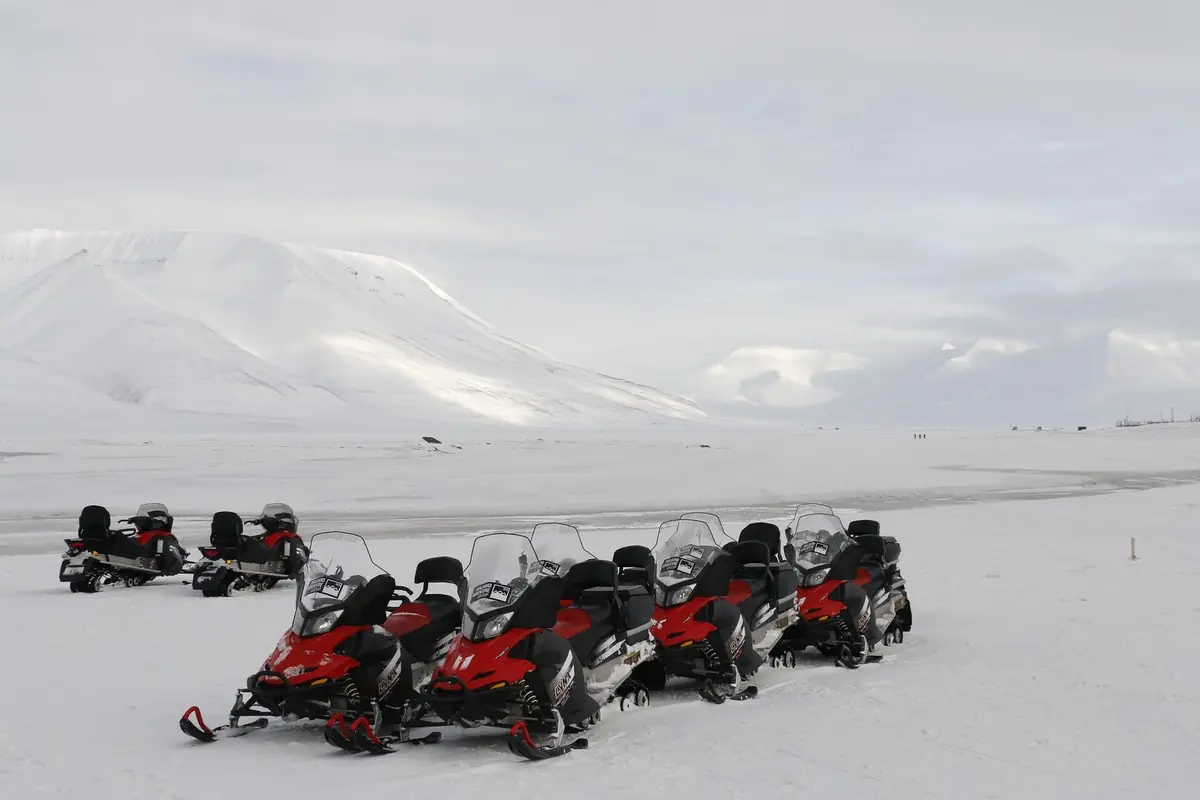
Snowmobiles are a major part of Svalbard's winter transport and tourism culture.
Organised trips can travel towards: glaciers, valleys, historic mining areas, remote cabins, fjords.
Off-road motorised travel is regulated, and snowmobiles may only operate in permitted areas.
33.21 Boat Trips
Summer boat trips provide access to landscapes that cannot easily be reached from Longyearbyen by road.
Possible experiences include: fjords, glaciers, bird cliffs, walrus habitats, abandoned settlements, coastal landscapes.
Boat excursions are strongly weather-dependent.
33.22 Kayaking
Kayaking around Svalbard offers an intimate perspective on the Arctic landscape.
Possible surroundings include: glaciers, fjords, ice, mountains, seabirds.
Kayaking should be undertaken through experienced operators because cold water, wind and changing ice conditions create serious risks.
33.23 Glacier Experiences
Svalbard contains extensive glacial landscapes.
Guided excursions can involve: glacier hiking, ice caves, snowmobile access, boat-based glacier viewing, ski touring.
Glaciers are dynamic environments.
Never enter an ice cave or approach unstable glacier fronts independently.
33.24 Ski Touring
Svalbard provides exceptional ski-touring terrain.
Visit Norway currently identifies the principal ski-touring season as approximately February–May, with some sail-to-ski opportunities extending into June.
The environment is treeless and exposed, making professional guiding particularly important.
33.25 Northern Lights in Svalbard
The Northern Lights season extends through the darker part of the year.
Svalbard's special advantage is the combination of aurora + extreme Arctic darkness + polar landscape.
During the Polar Night, aurora may appear even during periods when the landscape would still be relatively bright at lower latitudes.
Cloud cover remains the biggest practical obstacle.
33.26 Wildlife by Boat
Summer boat trips can provide opportunities to observe: walruses, seals, whales, seabirds, reindeer along the coast.
Wildlife sightings are never guaranteed.
Good operators prioritise animal welfare and keep appropriate distances.
33.27 Pyramiden
Pyramiden is an abandoned Soviet-era mining settlement.
It is one of Svalbard's most fascinating historical destinations.
Visitors can encounter: Soviet-era buildings, former mining infrastructure, cultural remnants, Arctic wilderness surrounding the settlement.
The site is generally visited as part of organised excursions.
33.28 Barentsburg
Barentsburg is an active Russian mining settlement on Svalbard.
It provides a striking contrast with Longyearbyen.
The community retains: Russian cultural identity, mining heritage, Soviet-era monuments, Arctic settlement architecture.
Access and tour arrangements can change, so check current conditions before planning a visit.
33.29 Ny-Ålesund
Ny-Ålesund is one of the world's northernmost research communities.
It is primarily a scientific settlement rather than a normal tourist town.
Research stations from several countries operate there.
Visitors may reach the area through organised expedition or boat excursions, subject to current access rules.
33.30 Svalbard's Arctic Research Role
Svalbard is important for: climate research, glaciology, atmospheric science, Arctic biology, geology, space research.
The archipelago's extreme environment makes it an important natural laboratory.
33.31 Svalbard Environmental Protection
Svalbard's environment is legally protected through extensive environmental regulations.
Visitors must: avoid disturbing wildlife, avoid picking flowers, leave cultural remains untouched, follow protected-area rules, respect camping restrictions, avoid unnecessary environmental impact.
Visit Svalbard specifically advises visitors to leave no lasting signs of their presence.
33.32 Travel Insurance
Travel insurance is particularly important here.
Visit Svalbard recommends insurance covering: medical assistance, unexpected events, Svalbard travel.
Standard travel insurance may not automatically cover search-and-rescue costs. Organised activities may include relevant SAR coverage, while independent wilderness travel can have additional requirements.
Check the policy before travelling.
33.33 Medical Facilities
Longyearbyen has a small hospital capable of dealing with emergencies.
For serious treatment, patients may need to be transported to mainland Norway.
This makes prevention and appropriate insurance particularly important.
33.34 Svalbard Packing List
Essential: waterproof outer shell, warm insulating layer, thermal base layers, hat, gloves, warm socks, waterproof boots, sunglasses, sunscreen, small backpack.
Winter — add: extremely warm clothing, windproof outerwear, insulated footwear, face protection, spare gloves.
Do not rely on ordinary Norwegian winter clothing for every Arctic excursion.
33.35 Photography in Svalbard
Summer — photograph: Midnight Sun, glaciers, wildlife, fjords, Arctic flowers, colourful Longyearbyen.
Winter — photograph: Northern Lights, snowmobiles, blue twilight, snow-covered mountains, Polar Night.
Cold-weather battery management is essential. Keep spare batteries warm inside your clothing.
33.36 Three-Day Longyearbyen Itinerary
Day 1 — Longyearbyen: town walk, Svalbard Museum, Svalbard Church, local cafés, mining history.
Day 2 — Arctic Adventure: choose snowmobile, dog sledding, boat trip, glacier excursion.
Day 3 — Nature & Culture: choose fjord excursion, museum, guided hiking, Northern Lights activity in the darker season.
33.37 Five-Day Svalbard Itinerary
- Day 1: arrive Longyearbyen.
- Day 2: museum + town exploration.
- Day 3: snowmobile or dog sledding.
- Day 4: boat/glacier excursion.
- Day 5: flexible weather day + Northern Lights or cultural activity.
A flexible day is valuable because Arctic weather can cancel outdoor excursions.
33.38 Seven-Day Svalbard Experience
Day 1: Longyearbyen. Day 2: museums and local history. Day 3: dog sledding. Day 4: snowmobile excursion. Day 5: fjord or glacier boat trip. Day 6: Pyramiden/Barentsburg excursion if operating. Day 7: flexible weather day.
33.39 Best Season
October–February — Northern Lights and Polar Night.
March–May — snowmobile, dog sledding and ski experiences.
June–August — boat trips, hiking and Midnight Sun.
September — autumn colours and transition towards darker nights.
The exact availability of activities changes from year to year.
33.40 Jan Mayen — Norway's Remote Volcanic Island
Jan Mayen is very different from Svalbard.
It is: remote, volcanic, mostly uninhabited, a nature reserve, home to a Norwegian station, dominated by Beerenberg, an active volcano.
Beerenberg reaches approximately 2,277 metres and is described by the official Jan Mayen site as the world's northernmost active volcano.
33.41 Jan Mayen Is Not a Normal Tourist Destination
This distinction is essential.
There are no commercial flights to Jan Mayen.
The official Jan Mayen site states that civilian flights are not available.
There are also no ordinary tourist hotels or public transport services.
Visits generally depend on organised vessels or specially authorised arrangements.
33.42 Access Restrictions
Jan Mayen is a protected nature reserve.
The official site states that access is restricted and visitors must coordinate in advance with the station.
For foreign visitors, prior permission is required under the current arrangements.
This makes Jan Mayen unsuitable for an ordinary spontaneous holiday.
Jan Mayen Access Warning
Access to Jan Mayen is restricted and depends on permission from the authorities.
Do not plan a trip to Jan Mayen without checking the latest official access status first.
33.44 Landing at Jan Mayen
There is no conventional harbour for ordinary tourist arrivals.
The official Jan Mayen information states that Kvalrossbukta is the designated landing point for visiting boats, subject to approval and conditions.
Landing can be cancelled at short notice because of: weather, sea conditions, station capacity, maintenance, safety, environmental considerations.
33.45 Jan Mayen's Wildlife
Jan Mayen is particularly important for seabirds.
The island and surrounding sea support: seabird colonies, marine wildlife, Arctic vegetation.
The nature reserve exists partly to protect the island's unique volcanic landscape, wildlife and cultural remains.
33.46 Beerenberg
Beerenberg dominates Jan Mayen's northern landscape.
Its volcanic profile is one of the island's defining visual features.
Mountaineering on Beerenberg is a serious expedition rather than an ordinary tourist hike.
Do not attempt an ascent without the necessary experience, permissions, equipment and local knowledge.
33.47 Jan Mayen Safety
Official information highlights several serious limitations: no normal tourist medical service, no public accommodation, no ordinary transport service, rough seas, strong winds, limited freshwater, difficult landings, limited rescue capability.
Jan Mayen should therefore be treated as a special expedition destination.
33.48 Svalbard vs Jan Mayen
- Tourist infrastructure — Svalbard: extensive in Longyearbyen. Jan Mayen: very limited.
- Commercial flights — Svalbard: yes. Jan Mayen: no.
- Hotels — Svalbard: yes. Jan Mayen: no public tourist hotels.
- Guided activities — Svalbard: many. Jan Mayen: very limited.
- Wildlife tourism — Svalbard: extensive. Jan Mayen: limited.
- Polar bears — Svalbard: yes. Jan Mayen: rarely.
- Major mountain — Svalbard: Arctic peaks/glaciers. Jan Mayen: Beerenberg.
- Main attraction — Svalbard: Arctic wilderness. Jan Mayen: remote volcanic island.
- Independent travel — Svalbard: highly restricted outside settlements. Jan Mayen: highly restricted.
Suitable for normal holiday — Svalbard: yes, with preparation. Jan Mayen: generally no.
Access — Svalbard: open to tourism. Jan Mayen: restricted, permission required.
33.49 Responsible Arctic Travel
The Arctic is not simply another tourism product.
Visitors should: minimise waste, respect wildlife, avoid disturbing birds, follow local regulations, stay with guides outside settlements, respect cultural remains, avoid unnecessary noise, use established operators, follow environmental rules.
Svalbard's community guidelines specifically ask visitors to respect wildlife, people, protected cultural heritage and the fragile environment.
33.51 Suggested Routes
Key places in Svalbard: Longyearbyen, Isfjorden, Adventdalen, Pyramiden, Barentsburg, Ny-Ålesund and Svalbard Airport.
Major glacier and fjord areas are reached by boat or on guided trips.
A separate small map should show: Jan Mayen, Beerenberg, Kvalrossbukta.
Check Before You Go — Svalbard
Passport/ID requirements, flight schedules, airport transfer, travel insurance, SAR coverage, polar-bear regulations, guide requirements, activity availability, weather, boat schedules, snowmobile conditions, museum opening hours, protected-area regulations, environmental fee, accommodation.
The Governor of Svalbard states that all visitors pay a NOK 150 environmental fee. It is added automatically to airline and cruise tickets; visitors arriving on private boats pay it themselves.
Check Before You Go — Jan Mayen
Before considering a visit, check: access restrictions, permission requirements, landing approval, vessel regulations, weather, nature-reserve rules and medical limitations. There are no commercial flights and no tourist accommodation.
33.54 Quick Reference
Svalbard — main settlement: Longyearbyen. Main island: Spitsbergen. Major wildlife: polar bear, reindeer, Arctic fox, walrus. Major activities: snowmobile, dog sledding, boat trips, hiking. Winter attraction: Northern Lights. Summer attraction: Midnight Sun. Major history: mining and exploration. Major research role: Arctic science. Travel gateway: Longyearbyen Airport.
Jan Mayen — main landmark: Beerenberg. Type: volcanic Arctic island. Status: nature reserve. Commercial flights: none. Tourist infrastructure: extremely limited. Access: restricted and permission-dependent.
33.55 Final Takeaway
Svalbard is one of the most extraordinary destinations in Norway's travel landscape.
It offers polar night, Midnight Sun, glaciers, wildlife, mining history, and true Arctic wilderness.
But Svalbard should never be treated like an ordinary city break.
The safest and most responsible approach is to use experienced local guides when travelling beyond Longyearbyen and to respect the strict environmental and wildlife regulations.
Jan Mayen is even more remote. Its volcanic landscape and Beerenberg are extraordinary, but its restricted access, limited infrastructure and difficult conditions make it an expedition-style destination rather than a standard holiday stop.