22.1 Introduction
Southern Helgeland is where the mainland begins to dissolve into an extraordinary coastal world of islands, skerries, fishing communities and shallow sheltered waters.
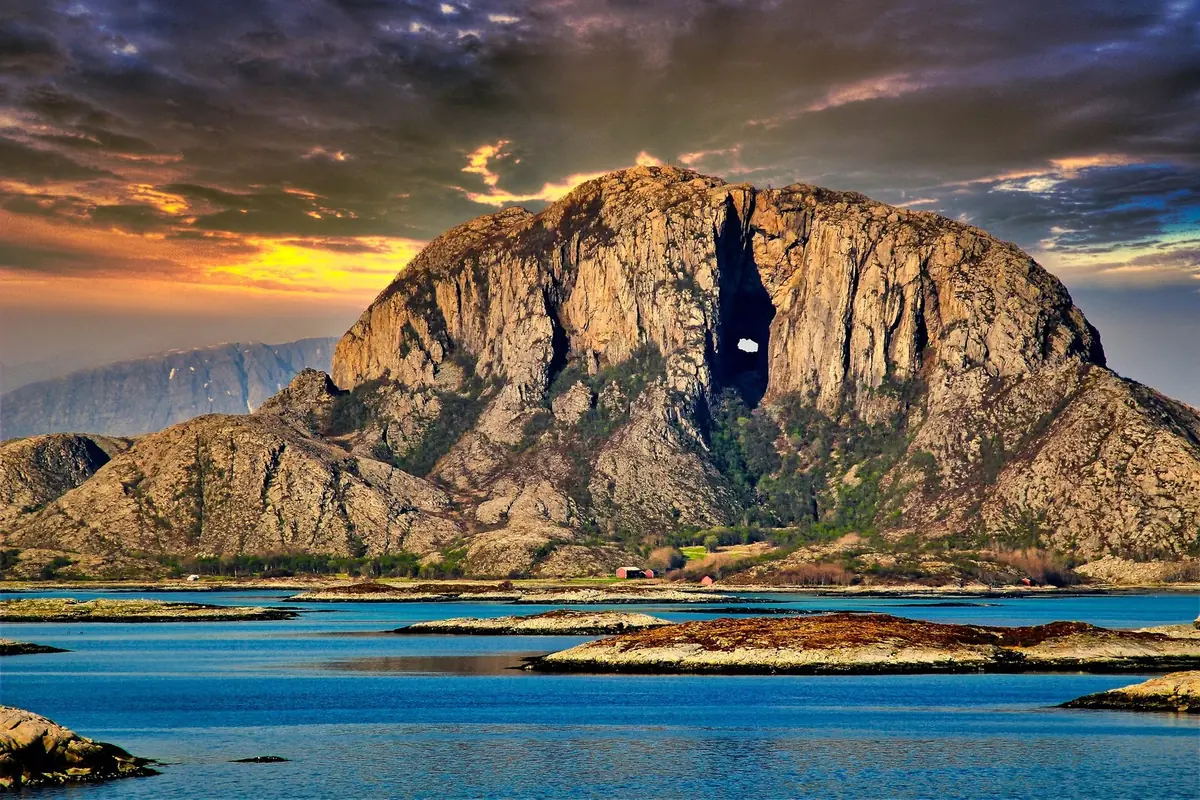
At the centre of this region is Brønnøysund, a small coastal town and an important gateway to Vega, Sømna, Torghatten and the wider Helgeland coast.
Beyond the mainland lies Vegaøyan — the Vega Archipelago, a UNESCO World Heritage cultural landscape shaped by generations of fishing, farming and the traditional tending of eider ducks.
The region is especially rewarding for travellers interested in: coastal road trips, island hopping, cycling, kayaking, UNESCO World Heritage, birdlife, fishing culture, local food, historic coastal communities, Midnight Sun, slow travel.
Brønnøysund lies directly on the Helgelandskysten Scenic Route, while Vega provides a natural island extension to the journey.
22.2 Brønnøysund at a Glance
Brønnøysund is a compact coastal town built on a narrow peninsula surrounded by sea and small islands.
It functions as: a regional service centre, a coastal transport hub, a road-trip base, a gateway to Vega, a base for kayaking and cycling, a starting point for Torghatten excursions.
The town became a municipality centre for agriculture, fishing, trade and tourism and has a long history of coastal settlement.
22.3 Exploring Brønnøysund on Foot
Brønnøysund is small enough to explore comfortably on foot.
A relaxed town walk can include: the harbour, waterfront, Brønnøy Church, historic buildings, local shops, cafés, restaurants, coastal viewpoints.
Visit Helgeland also offers an audio-guided historical walk that presents approximately 10,000 years of coastal history.
This is an excellent option when you have only a few hours before a ferry, boat or onward journey.
22.4 Brønnøy Church
Brønnøy Church is one of the town's important historic landmarks.
The church provides a useful introduction to the area's long relationship with Christianity, coastal settlement and regional history.
Combine the church with a waterfront walk and the town centre for a short cultural itinerary.
Always check current opening arrangements before planning an interior visit.
22.5 Brønnøysund Harbour
The harbour gives Brønnøysund much of its character.
Fishing boats, leisure boats, ferries and coastal vessels share the waterfront.
It is particularly atmospheric during: early morning, late afternoon, Midnight Sun, calm summer evenings.
Photographers should look for reflections of boats and buildings in the sheltered water.
22.6 Brønnøysund as a Transport Hub
Brønnøysund has: an airport, bus connections, road connections, coastal vessel access, boat connections towards Vega.
Visit Helgeland lists bus connections towards places including Mosjøen and Sandnessjøen, while boat connections include Vega.
This makes Brønnøysund useful for travellers who do not want to drive the entire Helgeland coast.
22.7 The Helgeland Coastal Highway
Brønnøysund lies along Fv17, the Coastal Highway and part of the Helgelandskysten Scenic Route.
The road provides access to one of Norway's most distinctive coastal journeys.
Instead of thinking of the region as one continuous road, think of it as a combination of: road + ferry + island + boat + bicycle.
That approach is particularly useful around Vega.
22.8 Brønnøysund and Vega
One of the most rewarding extensions from Brønnøysund is the journey to Vega.
The Scenic Route itinerary identifies the Brønnøysund–Vega section as approximately 54 km, including the ferry connection from Horn to Igerøy.
The ferry crossing is not merely a transport interruption. It is part of the travel experience.
As the mainland recedes, the island landscape begins to dominate the horizon.
22.9 Vega — A UNESCO World Heritage Landscape
Vega is not simply a beautiful island. It is a cultural landscape of outstanding universal value.
UNESCO inscribed Vegaøyan — The Vega Archipelago on the World Heritage List in 2004.
The property covers approximately 107,294 hectares, including around 6,881 hectares of land, and encompasses thousands of islands, islets and skerries.
Its significance comes from the long relationship between people + sea + farming + fishing + eider ducks + landscape.
22.10 Why Vega Became World Heritage
For roughly 1,500 years, generations of fishermen-farmers developed a distinctive way of life in this exposed coastal environment.
Fishing and farming were combined with the traditional tending of eider ducks.
Local people provided nesting shelters and protected the birds from disturbance and predators.
After the breeding season, the valuable down left in the nests could be collected.
UNESCO specifically recognises both this tradition and the important contribution of women to the eider-down process.
22.11 The Eider Duck Tradition
The eider tradition is one of the most distinctive aspects of Vega.
The relationship was based on protection rather than conventional domestication.
People created suitable nesting places for wild eiders and protected them during the breeding season.
The birds provided valuable down after nesting.
The tradition demonstrates how communities adapted to a difficult coastal environment using relatively small-scale resources.
The tradition continues today, although on a much smaller scale than historically.
22.12 Lånan — Living World Heritage
For travellers who want to understand the eider tradition beyond a museum exhibition, Lånan provides a particularly important experience.
Lånan is one of the key nesting areas in the Vega Archipelago.
During the appropriate summer period, visitors can experience the living tradition of the bird guardians and learn how the relationship between people and eiders continues today.
Visit Helgeland currently identifies June and July as the period when visitors can experience this tradition at Lånan.
Availability is seasonal, so confirm dates and transport before planning around it.
22.13 Respecting the Eider Birds
The World Heritage area is also a living natural environment.
During nesting season, visitors must be particularly careful.
Guidance from Visit Helgeland asks visitors to: keep distance from birds, avoid nesting areas, keep boats slow near shore, avoid disturbing wildlife, respect protected areas, keep dogs under control.
For visitors arriving by private boat, special care is required during the nesting period.
The goal is not simply to see the birds. It is to leave their habitat undisturbed.
22.14 Vega World Heritage Centre
The Vega World Heritage Centre at Gardsøy is the ideal starting point for understanding the island.
The centre documents: Vega's cultural history, fisher-farmer life, eider traditions, World Heritage values, coastal ecology, local landscape.
Its exhibitions include Wild, Beautiful Vega and Our World Heritage, together with changing exhibitions.
22.15 A Good First Visit to the World Heritage Centre
Allow approximately 45 minutes to two hours, depending on how deeply you explore the exhibitions and whether you add other activities.
A useful sequence: 1. Visit the World Heritage Centre. 2. Learn the story of the landscape. 3. Explore Vega by bicycle or car. 4. Visit the coastline. 5. Consider a guided island or eider experience.
This gives the scenery context rather than treating it simply as another beautiful Norwegian landscape.
22.16 The Children's World Heritage Centre
The World Heritage Centre also includes experiences designed for children.
Indoor and outdoor installations provide opportunities for: learning, play, sensory exploration, creative activities.
This makes Vega suitable for families as well as adults interested in cultural heritage.
22.17 Vega's Cultural Landscape
Vega's landscape is a mixture of: farms, meadows, beaches, lakes, mountains, rocky islands, fishing settlements, small harbours.
The landscape reflects centuries of human use.
In some areas, grazing and haymaking remain important to maintaining the traditional appearance of the countryside. UNESCO identifies the interaction between natural and cultural elements as a central part of the property's value.
22.18 Cycling on Vega
Vega is particularly attractive by bicycle.
Many areas are relatively low-lying, and the roads can provide a relaxed way to explore the island.
A typical cycling day can combine: World Heritage Centre → villages → farmland → coast → beach → café.
Visit Helgeland notes that many destinations on Vega can be reached within roughly 30–60 minutes by bicycle, depending on starting point and destination.
22.19 Why Cycling Works So Well Here
Cycling allows travellers to notice details that are easy to miss from a car: farmhouses, birds, wildflowers, small beaches, fishing boats, old roads, coastal views, island reflections.
An e-bike is particularly useful if you want to cover more of Vega without turning the day into a demanding cycling workout.
22.20 Vega by Car
A car provides more flexibility when: weather is unpredictable, travelling with children, carrying camping equipment, combining several distant attractions, travelling outside the main summer season.
However, parking and road access should never be used as a reason to enter sensitive natural areas.
22.21 Vegatrappa
The Vegatrappa is one of Vega's most recognizable hiking experiences.
The staircase climbs towards viewpoints on Ravnfloget, overlooking the island landscape.
Visit Helgeland describes the route as having around 2,000 steps, with rest areas along the climb.
The upper viewpoints provide views across: Vega, the northern archipelago, Søla, coastal waters.
22.22 Ravnfloget
Ravnfloget rises above the western side of Vega.
The area is known for both Vegatrappa and Ravnfloget Via Ferrata.
The Via Ferrata follows a prepared climbing route of approximately 225 metres. Visit Helgeland notes that previous rock-climbing experience is not required for the guided experience, but participants must meet the operator's current safety requirements.
22.23 Vegatrappa vs Via Ferrata
Vegatrappa — best for: hikers, families with older children, view-seekers, photographers.
Via Ferrata — best for: adventure travellers, people comfortable with heights, visitors looking for a more technical experience.
Do not confuse the two when planning your day.
22.24 Weather on Ravnfloget
The exposed coastal location means conditions can change quickly.
Rain, wind and low cloud can reduce visibility.
In colder months, stairs can become slippery because of frost, ice, snow.
Visit Helgeland specifically warns that Vegatrappa can become slippery with frost or snow.
Always check local conditions before climbing.
22.25 Kayaking Around Vega
The shallow waters around the Vega Archipelago are well suited to exploring by kayak when conditions are appropriate.
The landscape contains: small islands, islets, sheltered channels, beaches, bird habitats, fishing communities.
Visit Helgeland highlights kayaking as one of the principal ways to explore the archipelago.
22.26 Kayaking Safety
Even sheltered coastal water requires preparation.
Before launching, check: wind, tides, weather, wear a suitable personal flotation device, carry communication equipment, know your route, respect protected bird areas, keep distance from wildlife.
Beginners should consider a guided trip.
22.27 Vega's Beaches
Vega has numerous coastal areas where visitors can stop for a walk, picnic or photography.
The beaches are not necessarily traditional resort beaches.
Their attraction comes from: isolation, mountains, sea, birdlife, open horizons.
On a clear summer evening, the combination of beach and Midnight Sun can be spectacular.
22.28 Vega's Mountains
Although much of the island is relatively low-lying, the southwestern part rises into more substantial mountains.
This creates an unusual landscape: flat agricultural coast → lakes and fields → steep mountains → open sea.
It is one reason Vega works so well for both easy cycling and more demanding hiking.
22.29 Wildlife and Birdlife
The Vega Archipelago is particularly significant for birds.
UNESCO notes that approximately 228 bird species can be observed in the wider archipelago, which is considered an important Nordic wintering area for seabirds.
During the breeding season, visitors may encounter: eider ducks, seabirds, eagles, waders, gulls, other coastal species.
Wildlife viewing should always remain non-invasive.
22.30 The Importance of the Strandflat
The Vega landscape is part of Norway's coastal strandflat.
This produces the distinctive combination of: low islands, shallow water, rocky skerries, open sea, isolated mountains.
The geological setting helps explain why the region became so suitable for fishing, farming and island settlement.
22.31 Local Food on Vega
Vega's food culture naturally reflects its environment.
Look for: fresh seafood, fish, shellfish, local meat, seasonal vegetables, farm products, berries.
Visit Helgeland describes restaurants on Vega as offering seafood and farm-to-table food using local ingredients, with menus changing according to the season.
22.32 Vega Havhotell
For travellers looking for a more immersive island stay, Vega Havhotell provides accommodation on the northwestern side of Vega.
The location combines: ocean, mountains, hiking, island scenery, restaurant dining.
It can work particularly well for travellers who want to spend several days on Vega rather than making only a day trip.
22.33 Basecamp-Style Accommodation
Vega also offers simpler outdoor-oriented accommodation.
Base Camp Vega, for example, provides small cabins inspired by the traditional eider nesting houses, along with camping opportunities.
Its location is close to: Vegatrappa, Ravnfloget, kayaking waters.
This can be an excellent choice for active travellers.
22.34 Ylvingen
South of Vega lies Ylvingen, a small island with a strong connection to Norwegian coastal culture.
It became widely recognised through the Norwegian television series Himmelblå.
Today the island offers opportunities for: kayaking, coastal walks, food, accommodation, slow travel.
The island's small scale makes it particularly suitable for travellers who want to escape busy tourist centres.
22.35 Himmelblå Island Experience
A stay on Ylvingen can be structured around: arrival → local meal → kayak or coastal walk → evening by the sea → overnight stay.
The island is especially attractive during the bright summer season when daylight continues late into the night.
22.36 Sømna
Sømna lies close to Brønnøysund and offers a different side of southern Helgeland.
Instead of dramatic mountain peaks dominating every view, Sømna provides: agricultural landscapes, open coastal scenery, beaches, cycling, small communities.
It is useful as a slower road-trip section between major attractions.
22.37 Brønnøysund for Cyclists
Brønnøysund is well suited to cycling.
Possible trips include: town → Torghatten, coastal roads around Brønnøy, Sømna, island connections, multi-day Helgeland cycling.
Local bike rental is available in Brønnøysund, and Visit Helgeland promotes several cycling experiences from the town.
22.38 Brønnøysund by Kayak
The waters around Brønnøysund contain numerous islands and sheltered coastal areas.
Kayaking can provide a completely different perspective from the road.
Instead of looking at the archipelago from land, you move through it.
Possible sights include: seabirds, small islands, fishing boats, coastal houses, rock formations, shallow bays.
Guided tours are recommended for visitors unfamiliar with local sea conditions.
22.39 A Slow-Travel Day in Brønnøysund
09:00 Breakfast. 10:00 Town walk. 11:30 Brønnøy Church. 12:30 Lunch. 14:00 Cycling or kayaking. 17:30 Return to town. 19:00 Seafood dinner. 21:00 Harbour photography.
During summer, there is no need to finish the day early.
22.40 A Slow-Travel Day on Vega
09:00 Ferry arrival. 09:30 Bicycle collection. 10:00 Vega World Heritage Centre. 12:00 Lunch. 13:30 Cycling through the cultural landscape. 15:00 Vegatrappa. 17:30 Coastal stop. 19:00 Local dinner. Late evening — Midnight Sun photography.
Allow additional time if you plan a Via Ferrata or kayaking excursion.
22.41 Three-Day Southern Helgeland Itinerary
Day 1 — Brønnøysund: town walk, harbour, Brønnøy Church, local food, optional Torghatten excursion. Stay in Brønnøysund.
Day 2 — Vega: ferry to Vega, World Heritage Centre, cycling, Vegatrappa, coastal scenery. Stay on Vega.
Day 3 — Vega or Ylvingen: choose kayaking, Lånan experience if operating, hiking, Ylvingen, slow coastal day. Return to Brønnøysund or continue north.
22.42 Five-Day Itinerary
- Day 1: Brønnøysund.
- Day 2: Brønnøy and Sømna.
- Day 3: Vega World Heritage Centre + cycling.
- Day 4: Vegatrappa + kayaking.
- Day 5: Ylvingen or Lånan, depending on seasonal availability.
Continue towards Tjøtta and Sandnessjøen.
22.43 Seven-Day Southern Helgeland
Day 1: Brønnøysund. Day 2: Torghatten area. Day 3: Vega. Day 4: Vega cycling and World Heritage. Day 5: Ravnfloget/kayaking. Day 6: Ylvingen. Day 7: return to the mainland and continue north.
This itinerary is deliberately slow. It allows the traveller to experience the islands rather than simply photograph them from the roadside.
22.44 Best Time to Visit
- May — excellent for: spring landscapes, longer daylight, early cycling, fewer visitors. Some seasonal activities may not yet be operating.
- June — excellent for: green landscapes, birdlife, eider-related cultural experiences, long daylight.
- July — excellent for: cycling, kayaking, island hopping, Midnight Sun, outdoor activities. This is also a busy period.
- August — good for: hiking, cycling, coastal travel, food experiences.
September — potentially attractive for: autumn colours, fewer visitors, Northern Lights opportunities. Weather becomes less predictable.
Winter — best suited to: quiet coastal landscapes, local culture, photography, Northern Lights when conditions cooperate. Many seasonal island experiences operate only during the warmer months.
22.45 Midnight Sun
The southern Helgeland coast is particularly beautiful during the bright summer period.
The low evening sun creates: long shadows, golden light, reflections, colourful skies.
On Vega and the surrounding islands, the sea remains visible long after normal "sunset" hours.
22.46 Northern Lights
Northern Lights viewing is possible during the darker season.
Low population density and open coastal horizons can provide good viewing conditions.
However: no Northern Lights forecast guarantees a display. Clear skies, darkness and solar activity all matter.
Avoid planning an expensive trip solely around one predicted aurora night.
22.47 Photography Guide
- Brønnøysund — best subjects: harbour, boats, waterfront, old buildings, Torghatten from surrounding viewpoints.
- Vega — best subjects: World Heritage landscape, eider houses, coastal farms, Vegatrappa, Ravnfloget, Søla, beaches.
- Ylvingen — best subjects: small harbour, coastal houses, open sea, Midnight Sun.
22.48 Photography Ethics
The Vega Archipelago is not simply a photo backdrop.
When photographing birds: use a long lens, stay away from nests, do not chase birds, avoid drones near wildlife, follow protected-area rules.
The World Heritage area's value depends partly on maintaining the relationship between people and wildlife.
22.49 Family Travel
Southern Helgeland can work extremely well for families.
Good activities include: short town walks, cycling, beaches, World Heritage Centre, boat trips, easy coastal walks, wildlife observation, children's activities at the World Heritage Centre.
The more demanding mountain and Via Ferrata activities should be selected according to age, experience and current operator requirements.
22.50 Accessibility
Brønnøysund's central areas are generally easier to explore than remote coastal trails.
On Vega, accessibility varies significantly between: visitor centre, roads, beaches, hiking routes, outdoor attractions, boats.
The World Heritage Centre is designed for visitors of different ages and abilities, but outdoor routes should be assessed individually.
22.51 Responsible Tourism
Vega's World Heritage status makes responsible tourism particularly important.
Visitors should: respect nesting birds, keep dogs under control, avoid private property, take rubbish home, use designated facilities, follow local boating rules, avoid disturbing livestock, keep noise low, stay on appropriate paths.
During nesting season, visitors should be especially careful around eider habitats.
22.52 Island-Hopping Strategy
Do not try to visit every island. Instead choose a theme.
- Culture: Brønnøysund → Vega World Heritage Centre → Lånan.
- Adventure: Vega → Vegatrappa → Ravnfloget → kayaking.
- Cycling: Brønnøysund → Sømna → Vega.
- Slow travel: Vega → Ylvingen → coastal accommodation.
This makes the itinerary easier to manage.
22.53 Ferry Planning
Ferry travel is an essential part of Helgeland.
Before departure: 1. Check the exact route. 2. Check departure times. 3. Check whether reservations are required. 4. Check vehicle capacity rules. 5. Allow extra time. 6. Have an alternative plan if weather disrupts services. Use the current official ferry information rather than timetable screenshots from older travel guides.
22.54 Accommodation Strategy
- Brønnøysund — best for: restaurants, transport, short stays, road trips.
- Vega — best for: World Heritage, cycling, hiking, kayaking, slow travel.
- Ylvingen — best for: island atmosphere, coastal food, quiet evenings.
For summer travel, book accommodation and activities early.
22.56 Suggested Routes
Main route: Brønnøysund → Horn → Vega/Igerøy → Gardsøy → Ravnfloget → Ylvingen.
Also worth including: Sømna, Torghatten, the Vega World Heritage Centre and the island's cycling areas.
22.58 Check Before You Go
Brønnøysund accommodation, Vega ferry timetable, express-boat timetable, World Heritage Centre opening dates, Lånan visitor season, Vegatrappa conditions, Ravnfloget Via Ferrata availability, kayak operators, bike rental, Ylvingen accommodation, weather, road conditions, ferry prices, attraction prices, protected-area restrictions.
The World Heritage Centre publishes seasonal opening information; check the dates before visiting.
22.59 Quick Reference
Main town: Brønnøysund. Main island destination: Vega. UNESCO site: Vega Archipelago. UNESCO inscription: 2004. Signature cultural tradition: eider-down harvesting. Main visitor centre: Vega World Heritage Centre. Main hike: Vegatrappa. Adventure: Ravnfloget Via Ferrata. Island extension: Ylvingen. Main activities: cycling, kayaking, hiking and island hopping. Main road: Fv17/Helgelandskysten. Best stay: 3–7 days. Best for: slow travel, coastal culture, nature and UNESCO heritage.
22.60 Final Takeaway
Brønnøysund is more than a stop on the Helgeland coastal highway. It is the gateway to an island world where geography and culture are inseparable.
Vega adds something different to the Norway experience. Its significance does not come only from mountains or beaches. It comes from the relationship between people, farming, fishing, birds and the sea that developed over many centuries.
A memorable journey through this region could therefore look like: Brønnøysund → ferry → Vega → World Heritage Centre → bicycle → Vegatrappa → kayaking → Ylvingen → coastal road north.
The most important lesson is to slow down. Give the islands time. Listen to the local stories. Respect the birds. Travel by ferry. Cycle when possible. And allow the landscape to become part of the journey rather than simply something viewed through a car window.