Hardanger is one of Western Norway's great landscape regions: deep blue fjords, snow-covered mountains, waterfalls, fruit orchards, glaciers and historic villages combine to create a destination that can be explored by car, train, ferry, bicycle or on foot.
The region is particularly rewarding because its landscapes change dramatically within a relatively short distance. You can begin the day beside an apple orchard, drive through steep valleys, stand beside a powerful waterfall and finish beside a fjord.
The area covered in this chapter includes: Voss, Hardangerfjord, Norheimsund, Øystese, Eidfjord, Vøringsfossen, Måbødalen, Lofthus, Kinsarvik, Odda, Tyssedal, Trolltunga, Folgefonna, Hardangervidda.
Planning note: mountain roads, ferries, attractions, hiking conditions and opening hours can change between seasons. Always check conditions shortly before travelling.
13.1 Hardanger at a Glance
Region: Western Norway. Main gateway: Bergen. Major towns: Voss, Odda, Eidfjord, Norheimsund. Main fjord: Hardangerfjord. Famous waterfall: Vøringsfossen. Famous hike: Trolltunga. Mountain plateau: Hardangervidda. Major glacier: Folgefonna. Best road-trip period: late spring–early autumn. Best hiking period: generally June–September, depending on trail. Main transport: car, bus, train, ferry. Main airport access: Bergen Airport.
Hardanger is particularly suitable for travellers who want to combine sightseeing with outdoor activities.
13.2 Voss — The Adventure Centre
Voss sits between mountains and lakes and is one of Norway's best-known adventure destinations.
It is also unusually convenient for travellers without a car because the railway and bus station is in the centre of town, immediately beside the Voss Gondol.
Voss can be visited as a day trip from Bergen, but staying two or three nights gives you considerably more time for outdoor activities.
Visit Voss describes the destination as Norway's adventure capital, with rafting, kayaking, hiking, cycling, skiing, paragliding and other activities available across the seasons.
13.3 Voss Gondol
One of Voss's easiest ways to reach the mountains is the Voss Gondol.
The gondola travels from Voss Station to Hangurstoppen at approximately 820 metres above sea level in less than nine minutes.
At Hangurstoppen, visitors can enjoy: mountain panoramas, short walks, longer hikes, cycling, paragliding, restaurant and café, winter skiing, photography.
The approximately 800-metre Hanguren Panorama walk is designed as an easy route and is suitable for a wide range of visitors.
Accessibility: Voss Gondol and the top station have accessibility features, and the summer panorama trail is designed to accommodate wheelchair users.
Photography tip: go up around early morning or late afternoon for softer light over Voss and the surrounding mountains.
Check current gondola opening hours and ticket prices before visiting.
13.4 Voss Folk Museum
For travellers interested in traditional Norwegian life, Voss Folk Museum provides an alternative to the region's adventure activities.
The museum area contains historic farm buildings and provides insight into traditional architecture, farming and local culture.
It works particularly well as part of a rainy-day itinerary.
13.5 Bordalsgjelet Gorge
Bordalsgjelet is a dramatic gorge close to Voss town centre.
The gorge demonstrates how ice and water have shaped the landscape over thousands of years.
Because it is relatively close to the centre, it can be combined with: Voss Gondol, Voss town, Voss Folk Museum, a café lunch, a short afternoon walk.
13.6 Tvindefossen
Tvindefossen is one of the better-known waterfalls near Voss.
It makes an easy roadside stop and is particularly convenient for visitors travelling by car between Voss and the western fjord areas.
Waterfalls such as Tvindefossen and Skjervsfossen are among the natural attractions recommended by Visit Voss.
13.7 Voss for Adventure Travellers
Voss offers an unusually large selection of adventure activities.
Summer activities depending on the operator and conditions: whitewater rafting, river kayaking, stand-up paddleboarding, canyoning, mountain biking, hiking, paragliding, fishing, cycling, waterfall rappelling.
Rafting is one of the area's major summer activities, with trips available for beginners as well as experienced participants.
Waterfall rappelling: one specialist activity involves descending beside Skjervsfossen using climbing equipment. The current activity involves approximately 100 metres of descent in two rappels and is offered seasonally.
Always follow the operator's age, fitness and safety requirements.
13.8 Hardangerfjord
Hardangerfjord is one of Norway's major fjord landscapes.
The surrounding region combines: fjord villages, orchards, waterfalls, mountains, glaciers, scenic roads, hiking trails, historic farms.
The official Norwegian Scenic Route Hardanger is divided into four sections: 1. Granvin–Steinsdalsfossen. 2. Norheimsund–Tørvikbygd. 3. Jondal–Utne. 4. Kinsarvik–Låtefoss.
This makes Hardanger especially suitable for road trips where the journey itself is part of the attraction.
13.9 Norheimsund
Norheimsund is an important gateway to Hardanger.
It is a useful stop for: fjord views, cafés, local food, boat connections, scenic driving, Steinsdalsfossen.
Norheimsund can be included on a circular route from Bergen.
13.10 Steinsdalsfossen
Steinsdalsfossen is one of Hardanger's most accessible waterfalls.
A particularly interesting feature is the walking path that allows visitors to walk behind the falling water.
This makes it an excellent attraction for: families, photographers, short stops, travellers with limited hiking ability.
It can be combined with Norheimsund and the Hardanger Scenic Route.
13.11 Hardanger's Fruit Orchards
Hardanger is famous for its fruit-growing landscape.
During spring, orchards can become particularly spectacular as fruit trees bloom against the fjord and mountains.
The main products include: apples, pears, plums, cherries, apple juice, cider.
The orchard landscape is especially prominent around areas such as Lofthus, Kinsarvik and Ullensvang.
Responsible orchard tourism: do not enter private orchards without permission, do not pick fruit unless explicitly allowed, stay on marked roads and paths, buy directly from farm shops where available, respect agricultural operations.
13.12 Lofthus
Lofthus is one of the most beautiful villages around the Hardangerfjord.
The combination of fjord, orchards, mountains, waterfalls, historic farms makes it particularly attractive for photography.
Lofthus is also an excellent base for exploring the Ullensvang area.
Photography: for the classic Hardanger atmosphere, photograph the landscape when orchards are flowering, mountains still hold snow, the fjord is calm, low morning clouds sit over the mountains.
13.13 Kinsarvik
Kinsarvik is another useful base for exploring inner Hardanger.
It provides access toward: Hardangervidda, Eidfjord, Lofthus, Odda, Scenic Route Hardanger.
It is particularly useful for travellers building a multi-day road trip rather than simply visiting one attraction.
13.14 Eidfjord
Eidfjord sits at the inner end of the fjord system and provides a dramatic transition from fjord landscape to high mountain plateau.
It is one of the most convenient bases for visiting Vøringsfossen and travelling across Hardangervidda.
The official Hardangervidda Scenic Route runs between Eidfjord and Haugastøl and covers approximately 67 km.
Things to do around Eidfjord: Vøringsfossen, Måbødalen, Hardangervidda, fjord sightseeing, hiking, cycling, kayaking, scenic driving, local museums and cultural attractions.
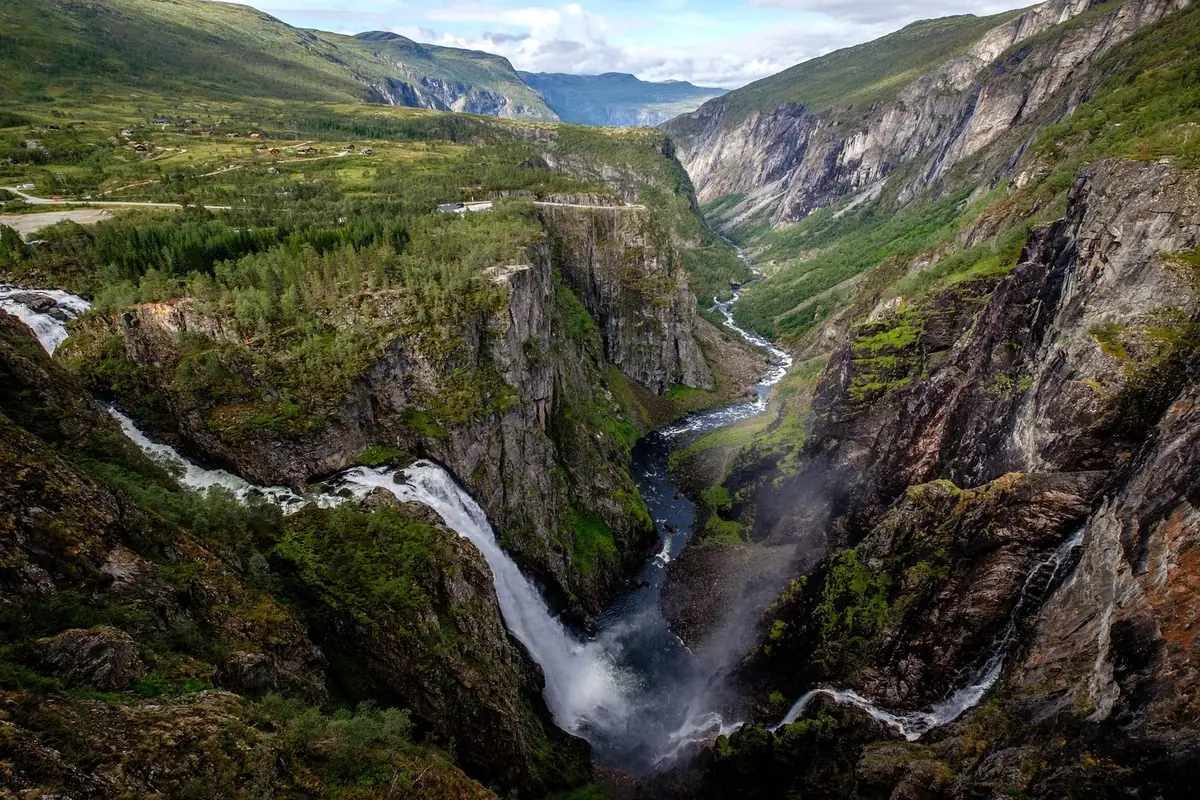
13.15 Vøringsfossen
Vøringsfossen is one of Norway's most famous waterfalls.
The waterfall drops approximately 182 metres into Måbødalen.
The attraction has been substantially developed with: viewing platforms, secured paths, bridges, parking, service buildings, accessible sections, electric vehicle charging at one parking area.
The official facility includes more than one kilometre of secured paths.
Best experience: allow at least 1–2 hours if you want time for several viewpoints and photographs. Do not simply stop at the first viewpoint and leave. The different viewing areas provide very different perspectives of the waterfall and valley.
Winter: some sections of Vøringsfossen are closed during winter because of snow and slippery conditions. Always check current conditions before travelling.
13.16 Måbødalen
Måbødalen is the dramatic valley between the high Hardangervidda plateau and Eidfjord.
The landscape changes rapidly: high plateau → steep mountain valley → waterfall → fjord.
This is one of the strongest scenic transitions in the region.
Drivers should take their time on the road and use designated stopping areas rather than stopping dangerously along narrow sections.
13.17 Hardangervidda
Hardangervidda is Europe's largest high mountain plateau and forms a spectacular contrast with the fjord landscape below.
The official Scenic Route crosses this high-altitude environment between Eidfjord and Haugastøl.
The plateau contains: mountain lakes, open wilderness, hiking routes, snowfields, glaciers visible in the distance, wild reindeer habitat.
Important winter warning: weather can change rapidly at high altitude. The road can experience snow, ice, strong winds, temporary closures, convoy driving.
The official Scenic Route information specifically warns that winter conditions can change quickly and that the mountain road may sometimes close.
Never plan a winter itinerary across Hardangervidda without checking road conditions.
13.18 Odda
Odda is one of the main adventure bases in southern Hardanger.
It is particularly important because it provides access to: Trolltunga, Tyssedal, Folgefonna region, Låtefossen, Sørfjorden, hiking and outdoor activities.
Odda is a practical place to stay if Trolltunga is the main objective.
13.19 Tyssedal
Tyssedal lies just outside Odda and is strongly connected with the industrial history of the region.
It is also one of the principal access points for Trolltunga.
The surrounding landscape demonstrates the combination of mountain water, hydroelectric power and heavy industry that helped transform this part of Norway.
13.20 Trolltunga
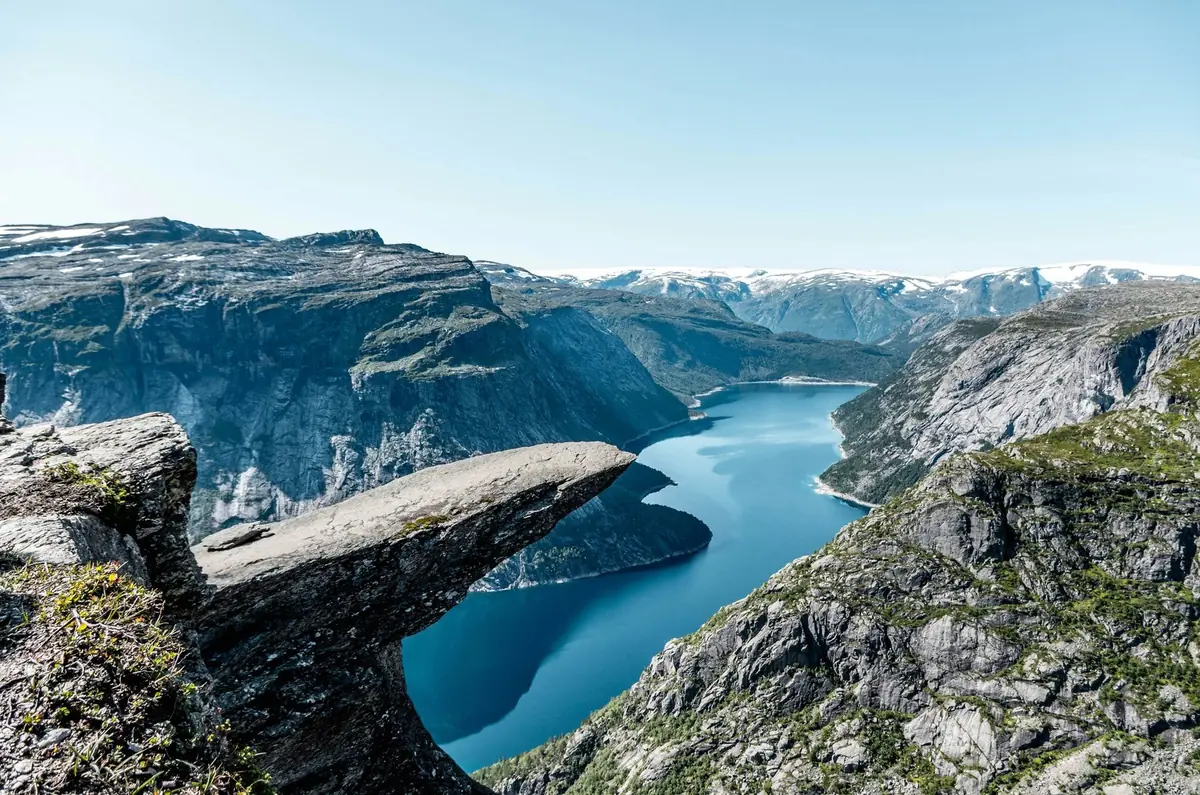
Trolltunga is one of Norway's most recognisable mountain formations.
The rock formation sits approximately 1,180 metres above sea level and projects dramatically from the mountain above Ringedalsvatnet.
But Trolltunga should not be treated as a simple sightseeing stop. It is a very demanding mountain hike.
Current trail distances: from P3 Mågelitopp — approximately 20 km round trip, around 7–10 hours. From P2 Skjeggedal — approximately 27 km round trip, around 8–12 hours. From P1 Tyssedal — approximately 38 km round trip, around 15 hours.
The official Trolltunga website classifies the hike as very demanding.
13.21 Trolltunga Hiking Season
For experienced hikers, the independent hiking season is 1 June – 30 September. Outside that period, hike only with a certified guide.
Outside this period, the official recommendation is to use a guide.
Even during summer, weather can change rapidly. Do not start if conditions include strong winds, heavy rain, dense fog, dangerous mountain weather.
The official trail guidance also recommends carrying suitable clothing and sufficient water.
Essential equipment: waterproof jacket, warm layer, wool base layer, hiking boots, extra socks, food, plenty of water, phone, power bank, headlamp, first-aid supplies, navigation equipment, weather-appropriate clothing.
13.22 Trolltunga Crowd Management
July and August are the busiest period.
The official Trolltunga information notes that the trail is particularly busy around midday, especially during peak summer.
If photography is important, consider starting early, avoiding Saturday, avoiding peak midday, allowing extra time.
There may be a queue for the famous photograph on the rock itself.
Never take unnecessary risks for a photograph.
13.23 Trolltunga Guided Hikes
A guided hike is strongly recommended for visitors unfamiliar with Norwegian high-mountain conditions.
Guides can help with: route planning, weather decisions, mountain safety, navigation, equipment, emergency procedures.
There are also emergency shelters along the trail.
Shuttle-bus dates and parking prices are set each season, so check them before you travel.
Use the official Trolltunga website for the latest: trail conditions, shuttle buses, parking, road restrictions, guided tours, seasonal opening information.
13.24 Folgefonna
Folgefonna is one of the major glaciers of Western Norway.
The glacier landscape provides opportunities for experienced visitors and guided activities, depending on season and conditions.
Possible experiences include: glacier walks, guided glacier tours, hiking, scenic viewpoints, glacier photography.
Never walk onto a glacier independently unless you have the appropriate knowledge and equipment.
Crevasses and rapidly changing conditions make glaciers fundamentally different from ordinary hiking trails.
13.25 Låtefossen
Låtefossen is one of the most photographed waterfalls in the Hardanger region.
It is particularly convenient for road-trippers travelling between Odda and southern Hardanger.
The waterfall is split into two streams and falls dramatically beside the road.
Photography tip: a wide-angle lens is useful because the waterfall rises dramatically above the surrounding road and landscape.
Expect spray close to the waterfall. Protect cameras and phones with waterproof cover, microfibre cloth, lens protection.
13.26 Hardanger by Car
A road trip is one of the best ways to experience Hardanger because attractions are spread across the region.
Suggested route: Bergen → Voss → Granvin → Norheimsund → Hardangerfjord → Eidfjord → Vøringsfossen → Kinsarvik → Lofthus → Odda.
This route can be shortened or extended depending on the traveller's interests.
Allow extra time: Norwegian mountain roads are not designed for fast driving. Allow time for ferries, roadworks, tunnels, narrow roads, photography stops, weather, traffic, slow-moving vehicles.
The official Scenic Route description specifically emphasises adapting to the natural pace of the Hardanger landscape.
13.27 Hardanger Without a Car
Hardanger is possible without a car, particularly if you combine Bergen, Voss, train, bus, ferry, local tours.
Voss is particularly convenient because the railway station is directly connected to the town and gondola.
Voss has train connections from both Bergen and Oslo.
For remote attractions, however, public transport can be seasonal or limited.
Always check the current timetable before building a car-free itinerary.
13.28 Three-Day Hardanger Itinerary
Day 1 — Bergen → Voss: Morning — train from Bergen to Voss, Voss town centre, Voss Gondol, Hanguren Panorama. Afternoon — Voss Folk Museum, Bordalsgjelet, local dinner. Night: Voss.
Day 2 — Voss → Eidfjord: Morning — depart Voss, scenic drive toward Hardanger, stop at waterfalls and viewpoints. Afternoon — arrive Eidfjord, visit Vøringsfossen, explore Måbødalen. Evening — fjordside dinner. Night: Eidfjord.
Day 3 — Eidfjord → Lofthus → Odda: Morning — scenic drive along Hardangerfjord, Kinsarvik, Lofthus, orchard landscape. Afternoon — continue toward Odda, stop at Låtefossen. Evening — explore Odda. Night: Odda.
13.29 Five-Day Hardanger Itinerary
- Day 1: Bergen → Voss.
- Day 2: Voss adventure day — choose gondola + hiking, rafting, kayaking, cycling.
- Day 3: Voss → Hardanger → Eidfjord — include Steinsdalsfossen, fjord viewpoints, Vøringsfossen.
- Day 4: Eidfjord → Kinsarvik → Lofthus → Odda — focus on orchards, fjord scenery, waterfalls, local food.
- Day 5: Odda/Trolltunga. For Trolltunga, reserve a full day and plan according to official trail conditions.
13.30 Seven-Day Hardanger Adventure
- Day 1: Bergen → Voss.
- Day 2: Voss adventure activities.
- Day 3: Voss → Norheimsund → Hardanger.
- Day 4: Eidfjord + Vøringsfossen + Hardangervidda.
- Day 5: Kinsarvik + Lofthus + fjord villages.
- Day 6: Odda + Låtefossen + local hiking.
- Day 7: Trolltunga or Folgefonna experience.
This itinerary gives travellers flexibility to move activities around according to weather.
13.31 Best Time to Visit
Spring (April–May) — good for: waterfalls, flowering orchards, fewer visitors, scenic driving. Mountain hiking can still be affected by snow.
Summer (June–August) — best for: hiking, Trolltunga, rafting, cycling, kayaking, long days, mountain activities. This is also the busiest period. Autumn (September–October) — excellent for: autumn colours, photography, quieter roads, cooler temperatures. High mountain weather can change quickly.
Winter (November–March) — best suited to: snow landscapes, skiing around Voss, winter photography, selected fjord experiences. Hardangervidda and mountain roads require careful planning.
13.32 Family Travel
Hardanger can work very well for families if the itinerary is not built entirely around demanding hikes.
Good family options include: Voss Gondol, Hanguren Panorama, Steinsdalsfossen, Vøringsfossen viewpoints, fjord sightseeing, short walks, farm visits, scenic drives, easy cycling routes.
For young children, avoid turning every day into a long driving day.
13.33 Photography Guide
- Voss: gondola, mountains, Vangsvatnet.
- Hardanger: orchards, fjord, snowy mountains.
- Eidfjord: fjord, mountain walls, Vøringsfossen.
- Odda: Sørfjorden, waterfalls, mountains.
- Trolltunga: Ringedalsvatnet, mountain landscapes.
- Recommended shooting times: early morning — calm water, soft light, fewer people. Evening — warm mountain light, longer shadows, atmospheric landscapes.
Always prioritise safe positioning over getting a dramatic photograph.
13.34 Food to Try
Look for regional products such as: Hardanger apples, apple juice, local cider, Norwegian brown cheese, lamb, salmon, trout, local berries, traditional Norwegian baked goods.
Farm shops and local producers can be particularly interesting during the fruit season.
13.35 Where to Stay
- Voss — best for: adventure activities, public transport, short mountain trips, families.
- Norheimsund — best for: northern Hardanger, scenic driving, Bergen connection.
- Eidfjord — best for: Vøringsfossen, Hardangervidda, fjord scenery.
- Lofthus/Kinsarvik — best for: orchards, fjord views, relaxed stays.
- Odda — best for: Trolltunga, Låtefossen, southern Hardanger, hiking.
13.36 Hardanger Budget Guide
Budget traveller — hostels, campsites, self-catering, public transport, free viewpoints, short hikes.
Mid-range traveller — hotels, guesthouses, rental car, paid attractions, selected guided activities.
Adventure traveller — budget extra for guided Trolltunga, rafting, kayaking, glacier activities, equipment rental, scenic tours.
Price note: transport, gondola tickets, parking, tours and accommodation prices change, so check them before booking.
13.38 Suggested Routes
Main route: Bergen → Voss → Granvin → Norheimsund → Eidfjord → Kinsarvik → Lofthus → Odda → Tyssedal/Trolltunga.
Also worth including: Steinsdalsfossen, Vøringsfossen, Måbødalen, Låtefossen, Folgefonna, Hardangervidda and the main ferry crossings.
13.40 Responsible Travel
Hardanger's landscape is beautiful but fragile.
Visitors should: stay on marked trails, take rubbish with them, respect private property, avoid entering private orchards, follow parking restrictions, use designated campsites where required, respect wildlife, keep fjords and rivers clean, follow fire restrictions, use toilets where available, avoid unnecessary drone flights, never block narrow roads for photographs.
Mountain visitors should always respect weather warnings.
13.41 Accessibility
Several attractions provide better accessibility than traditional mountain hikes.
Potentially suitable options include: Voss Gondol, Hanguren Panorama, selected Vøringsfossen viewing areas, scenic drives, fjord cruises.
Accessibility can vary by weather, construction and seasonal opening.
Travellers with mobility requirements should verify conditions directly before visiting.
13.42 Check Before You Go
Before starting your Hardanger trip, check: road conditions, ferry timetable, weather forecast, Trolltunga trail status, Trolltunga shuttle buses, parking availability, Voss Gondol opening hours, Vøringsfossen winter restrictions, Hardangervidda road status, accommodation availability, glacier-tour conditions, activity age requirements, current prices, charging stations if driving an EV.
Especially important: for Trolltunga, check the official trail information at trolltunga.com immediately before departure. Independent hiking is recommended only from 1 June to 30 September for experienced hikers; outside that period, go with a guide.
For Hardangervidda, check mountain-road conditions before driving, particularly in winter.
13.43 Quick Reference
| Voss | gondola & adventure activities | 1–2 days |
|---|---|---|
| Norheimsund | Steinsdalsfossen & fjord | ½–1 day |
| Eidfjord | Vøringsfossen & fjord | 1–2 days |
| Hardangervidda | mountain plateau | ½–1 day |
| Lofthus | orchards & fjord | ½–1 day |
| Kinsarvik | fjord & hiking | ½–1 day |
| Odda | mountains & waterfalls | 1–2 days |
| Trolltunga | major mountain hike | 1 full day |
| Folgefonna | glacier region | 1–2 days |
13.44 Final Takeaway
Hardanger is not simply one attraction. It is a complete landscape journey.
A traveller can experience: Voss adventure → Hardanger orchards → fjord villages → Eidfjord → Vøringsfossen → Hardangervidda → Lofthus → Odda → Trolltunga within one carefully planned journey.
For first-time visitors, the ideal strategy is to avoid rushing. Choose a few major experiences, leave room for weather changes, and allow the roads, ferries and mountain landscape to determine the pace.
Hardanger is at its best when the journey itself becomes part of the destination.