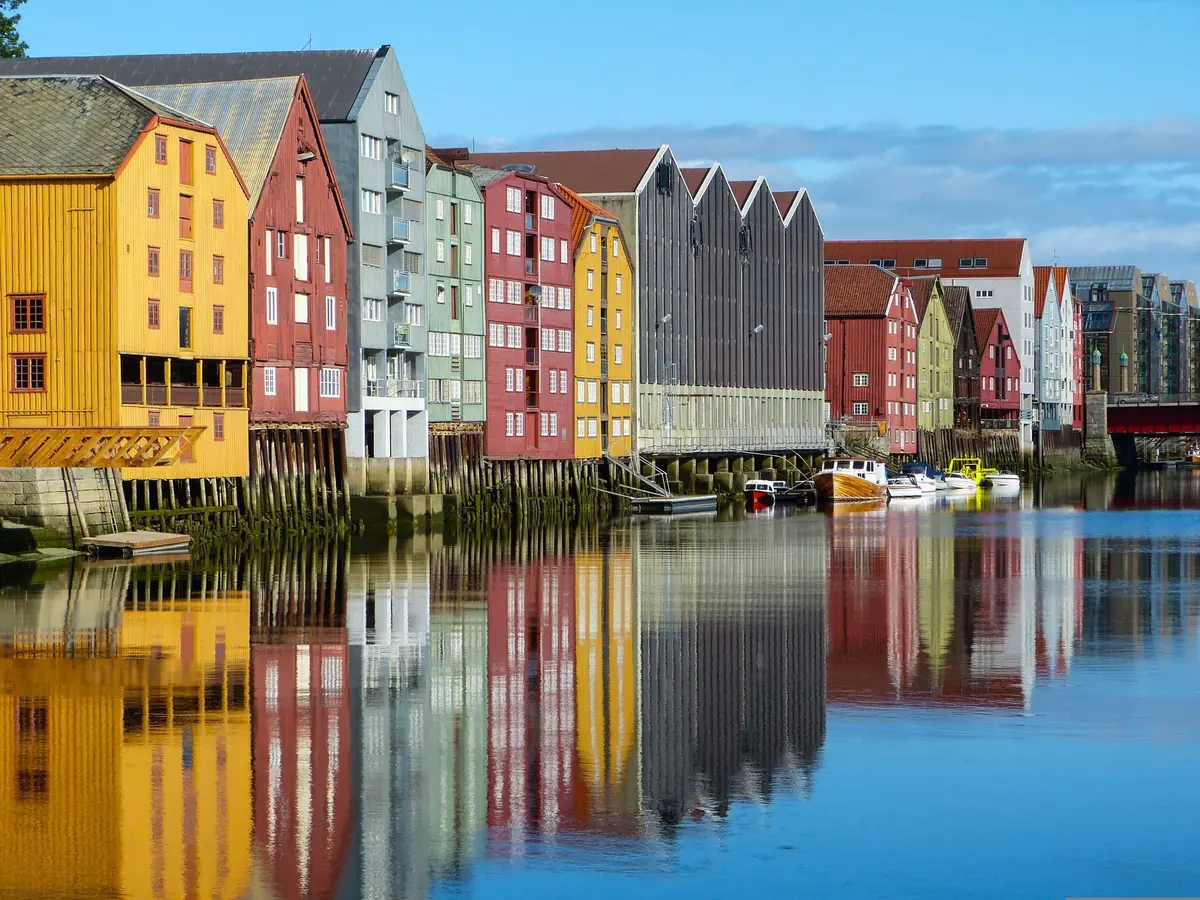
Trondheim is one of Norway's most rewarding cities for travellers who want to combine history, architecture, food and a relaxed urban atmosphere.
Founded in 997, Trondheim played an important role in Norway's early history and was the country's capital during the Viking Age. Today it is a compact, walkable city where medieval heritage sits alongside cafés, museums, university life and modern Nordic culture.
The city's greatest landmark is Nidaros Cathedral, Norway's national shrine and one of Europe's major pilgrimage destinations. Around it you'll find the Archbishop's Palace, historic wooden buildings, the Nidelva river, Bakklandet and the famous Gamle Bybro bridge.
5.1 Trondheim at a Glance
- Region: Trøndelag
- Location: Central Norway
- Ideal stay: 2–3 days
- Best for: History, architecture, food, museums, cycling, culture and city walks
Trondheim is particularly easy to explore without a car. The city centre is compact and pedestrian-friendly, while buses and trams provide connections to areas farther from the centre.
Perfect for: couples, families, history lovers, food travellers, photographers, students and young travellers, rail travellers, visitors travelling between southern and northern Norway.
5.2 Nidaros Cathedral — The Heart of Trondheim
No visit to Trondheim is complete without seeing Nidaros Cathedral.
The cathedral was built over the burial site of St. Olav, the Viking king who became Norway's patron saint. Construction began around 1070, and the building developed into one of Scandinavia's most important medieval religious sites.
Its Gothic architecture, detailed stone carvings and famous western façade make it one of Norway's most impressive historic buildings.
Inside the Cathedral, visitors can admire: Gothic architecture, stone sculptures, stained glass, the rose window, historic chapels, religious art, the cathedral's long restoration history.
During the summer season, visitors may also have the opportunity to climb the tower. The climb includes 172 steps and rewards visitors with views across Trondheim.
Current visitor information — the official cathedral website currently lists: Monday–Friday 09:00–14:00, Saturday 09:00–13:00, Sunday 13:00–16:00. Opening times can change because of church services, events and holidays, so travellers should check the official website before visiting.
The cathedral lists adult admission at NOK 140, with separate prices for younger visitors and an extra charge for the tower climb, which is open in summer only. Opening hours are shorter on Saturdays and Sundays. Check current prices and hours at nidarosdomen.no before visiting.
5.3 Archbishop's Palace
Next to Nidaros Cathedral stands the Archbishop's Palace, one of Trondheim's most important historic complexes.
The palace has been connected with the cathedral and the archbishops of Nidaros for centuries.
Today visitors can explore the museum and learn more about Trondheim's religious and political history.
The complex also includes the exhibition of the Norwegian Crown Regalia.
Suggested visit: allow approximately 1.5–2.5 hours for Nidaros Cathedral, the Archbishop's Palace and the Crown Regalia if you want to explore the complex properly.
5.4 Gamle Bybro — The Old Town Bridge
The historic Gamle Bybro crosses the Nidelva river and is one of Trondheim's most photographed landmarks.
The bridge provides excellent views of the colourful wooden warehouses lining the river.
It also connects the cathedral area with Bakklandet, making it a natural part of a walking tour.
Photography tip: stand on the bridge and photograph the river with the colourful wooden buildings behind it. For a different perspective, walk along the riverbank and photograph the bridge itself.
5.5 Bakklandet — Trondheim's Most Charming Neighbourhood
Bakklandet is one of the best areas in Trondheim for a relaxed afternoon.
The historic neighbourhood is characterised by: wooden houses, cobbled streets, small cafés, restaurants, independent shops, river views, cycling culture.
The area was once associated with industry and working life but has developed into one of Trondheim's most popular neighbourhoods.
What to do: take a slow walk through Bakklandet, stop for coffee, photograph the colourful buildings and then continue towards Gamle Bybro.
5.6 Trampe Bicycle Lift
One of Trondheim's unusual attractions is Trampe, a bicycle lift designed to help cyclists climb the steep hill in Bakklandet.
It has become one of the city's symbols of cycling culture.
Trondheim is particularly bicycle-friendly, and the city promotes cycling as an important form of local transport.
Travel idea: rent a bicycle and combine Bakklandet → Nidelva → city centre → Kristiansten → Solsiden.
5.7 Nidelva River & Wooden Warehouses
The Nidelva is central to Trondheim's identity.
Historic wooden warehouses line parts of the river, creating one of the city's most recognisable views.
A riverside walk is particularly enjoyable around: Gamle Bybro, Bakklandet, Kjøpmannsgata, Nedre Bakklandet.
The combination of water, colourful architecture and bridges makes this one of the best areas for photography.
5.8 Kristiansten Fortress
Located on a hill above Trondheim, Kristiansten Fortress provides historical interest and views over the city.
The fortress was built as part of Trondheim's defensive system and remains an important historic landmark.
Why visit? City panorama, historical architecture, photography, short uphill walk, outdoor space.
It is particularly attractive during good weather when you can combine the fortress with a walk through Bakklandet.
5.9 Rockheim — Norway's National Museum of Popular Music
For something completely different from medieval architecture, visit Rockheim.
Rockheim explores Norwegian popular music and cultural history.
The museum is especially suitable for visitors interested in: rock, pop, Norwegian music, interactive exhibitions, modern culture.
Visit Norway lists Rockheim among Trondheim's major museums.
Recommended time: approximately 1.5–2.5 hours.
5.10 PoMo
Trondheim's cultural scene has expanded beyond traditional museums.
PoMo is a contemporary art museum in the city centre and is one of the newer cultural attractions highlighted by Visit Norway.
It is a useful addition to an itinerary for travellers who enjoy modern art and architecture.
Combine with: Nidaros Cathedral, Torvet, cafés, shopping streets, Bakklandet.
5.11 Torvet
Torvet, Trondheim's central square, is a natural meeting point in the city centre.
The square is dominated by the monument to Olav Tryggvason, traditionally associated with the city's foundation.
From Torvet you can easily walk towards: Nidaros Cathedral → Munkegata → shopping streets → Nidelva.
5.12 Stiftsgården
Trondheim is also home to Stiftsgården, the city's historic royal residence.
The building is an important part of Trondheim's architectural heritage and is located within walking distance of the central attractions.
If the interior is open to visitors during your trip, check the current tour schedule before planning your visit.
5.13 Solsiden
For a modern contrast to historic Bakklandet, head towards Solsiden.
The former industrial waterfront has developed into an area known for: restaurants, cafés, bars, waterfront walks, modern architecture, evening atmosphere.
It is especially popular later in the day.
Best time: late afternoon to evening is a good time to combine Solsiden with dinner.
5.14 Trondheim's Food Scene
Trondheim and the wider Trøndelag region have developed a strong reputation for local food.
Visit Norway describes Trondheim as a destination for Nordic flavours, with local ingredients and a strong culinary identity.
The city has also attracted high-end restaurants, including Michelin-starred establishments.
But you do not need a luxury budget to experience local food.
Try: Norwegian seafood, local salmon, brown cheese, Norwegian waffles, local dairy products, game meat, bakery products, seasonal vegetables, local craft beverages.
5.15 Nidaros Pilgrimage
Trondheim has been an important pilgrimage destination for almost 1,000 years.
Pilgrims historically travelled to Nidaros Cathedral to visit the burial place of St. Olav.
Today, the tradition continues through the St. Olav Ways, a network of pilgrimage routes leading towards Trondheim.
The Nidaros Pilgrim Centre welcomes pilgrims and other visitors throughout the year.
For ordinary tourists: you do not have to complete a long pilgrimage to experience this side of Trondheim. Even a short walk through the cathedral area can introduce you to the city's pilgrimage heritage.
5.16 Trondheim by Public Transport
Public transport is operated primarily through AtB.
The network includes: city buses, trams, regional buses, some train services within the relevant ticket zone, on-demand transport, boats in parts of Trøndelag.
The AtB app can be used for journey planning and ticket purchases. It supports route searches and real-time travel information.
Zone A — AtB's Zone A includes Trondheim and several surrounding municipalities. For visitors staying mainly within Trondheim, Zone A is particularly relevant.
AtB sells single tickets, 24-hour tickets and other ticket types. Fares change, so check the current fares at atb.no before travelling.
5.17 Getting to Trondheim
By Air — Trondheim Airport Værnes is the principal airport serving the region. From the airport, travellers can continue towards Trondheim using public transport and other transfer options.
By Train — Trondheim is connected to other parts of Norway by rail. Rail travel can be particularly attractive for visitors who want to experience Norwegian landscapes rather than simply fly between cities.
By Bus — Long-distance bus connections also link Trondheim with other Norwegian destinations. For current schedules, always check the operator before booking.
5.18 Trondheim to Oslo
Trondheim and Oslo can be connected by a combination of train and bus services depending on current schedules and operational conditions.
Vy currently lists a route where travellers can use Vy Express VY710, including direct overnight bus services between Trondheim and Oslo. Daytime travel can involve a bus/train combination through Lillehammer, with a journey time of around 7 hours 30 minutes.
Travel tip: timetables change, so check the Vy or Entur journey planner (vy.no, entur.no) for your travel date rather than relying on a fixed departure time.
5.19 A Perfect 1-Day Trondheim Itinerary
09:00 Breakfast in the city centre. 09:30 Walk to Nidaros Cathedral. 11:00 Explore Archbishop's Palace. 12:30 Lunch near the city centre. 13:30 Walk towards Gamle Bybro. 14:00 Explore Bakklandet. 15:30 Coffee break. 16:00 Walk towards Kristiansten Fortress. 18:00 Return towards Solsiden. 19:00 Dinner. Evening: take a relaxed walk beside the Nidelva.
5.20 A Perfect 2-Day Trondheim Itinerary
Day 1 — Historic Trondheim: Nidaros Cathedral, Archbishop's Palace, Crown Regalia, Gamle Bybro, Bakklandet, Kristiansten Fortress, Solsiden.
Day 2 — Culture & Local Life: Morning — Rockheim. Afternoon — PoMo, Torvet, Stiftsgården, shopping streets. Evening — restaurant, Nidelva waterfront, Bakklandet café.
5.21 Trondheim in Summer
Summer is an excellent season for exploring Trondheim on foot and by bicycle.
Long daylight hours make it possible to combine multiple attractions in one day.
Visit Norway highlights Bakklandet, cycling, cafés, the Nidelva river and Nidaros Cathedral among the city's summer experiences.
Summer checklist: Nidaros Cathedral, Bakklandet, Gamle Bybro, cycling, river walk, outdoor café, museums, local food.
5.22 Trondheim in Winter
Winter gives Trondheim a completely different atmosphere.
Snow and cold weather can transform the wooden buildings along Nidelva and Bakklandet.
Visit Norway specifically highlights Nidaros Cathedral, Gamle Bybro, Bakklandet and Trondheim's Christmas atmosphere as winter experiences. Winter packing: warm jacket, waterproof footwear, gloves, hat, thermal layers, warm socks, small backpack.
5.23 Family-Friendly Trondheim
Families can combine: Nidaros Cathedral, Bakklandet, bicycle experiences, museums, river walks, parks, interactive cultural attractions.
A shorter itinerary is usually better with young children.
Instead of visiting six museums, select one major museum and leave time for cafés, parks and outdoor exploration.
5.24 Photography Guide
Best subjects: 1. Nidaros Cathedral — use the cathedral façade for architectural photography. 2. Gamle Bybro — photograph the bridge with the colourful warehouses. 3. Nidelva — try reflections during calm weather. 4. Bakklandet — focus on wooden houses and narrow streets. 5. Kristiansten — use the elevated position for a wider city view. 6. Solsiden — photograph the waterfront during the evening.
5.25 Suggested Routes
Route 1 — Trondheim city walk: Trondheim Central Station → Torvet → Nidaros Cathedral → Gamle Bybro → Bakklandet → Kristiansten Fortress → Solsiden → Rockheim.
Route 2 — regional: Trondheim → Stjørdal/Værnes → Røros → inner Trøndelag.
5.27 Trondheim Quick Reference
| Nidaros Cathedral | 1–1.5 hrs | history/architecture |
|---|---|---|
| Archbishop's Palace | 1–1.5 hrs | history |
| Gamle Bybro | 20–40 min | photography |
| Bakklandet | 1–2 hrs | walking/cafés |
| Kristiansten Fortress | 45–90 min | views/history |
| Rockheim | 1.5–2.5 hrs | music |
| PoMo | 1–2 hrs | modern art |
| Torvet | 20–30 min | city centre |
| Solsiden | 1–3 hrs | food/evening |
| Nidelva | 30–90 min | walking/photography |
5.29 Trondheim in One Sentence
Trondheim is where Norway's medieval history, colourful wooden neighbourhoods, riverfront culture and modern Nordic food scene come together in one highly walkable city.
Chapter Checklist
Before you travel, check: Nidaros Cathedral opening hours and admission prices, tower-climb availability, museum opening hours, AtB fares, airport transport, train and bus schedules, events and festivals, and restaurant opening times.
Tourist information, prices, schedules and opening hours change, so check the official sources named in this chapter before you go.